Partial Knee Replacement Surgery: Recovery Time, Benefits and What to Expect
Knee pain rarely announces itself all at once. It starts small, maybe a twinge on the stairs, and slowly rearranges how you move through a day. You start avoiding the stairs. You sit down more carefully. At some point you notice you’ve stopped doing things you didn’t even think of as “activities” before, like a walk around the block.
For a lot of people, this happens because arthritis has damaged just one part of the knee, not the entire joint. When that’s the case and other treatments haven’t helped much, partial knee replacement surgery becomes a reasonable thing to discuss with an orthopedic surgeon.
Unlike a total knee replacement, this operation only touches the damaged section. The rest of the knee, the parts that are still working fine, gets left alone.
What Is Partial Knee Replacement, Exactly?
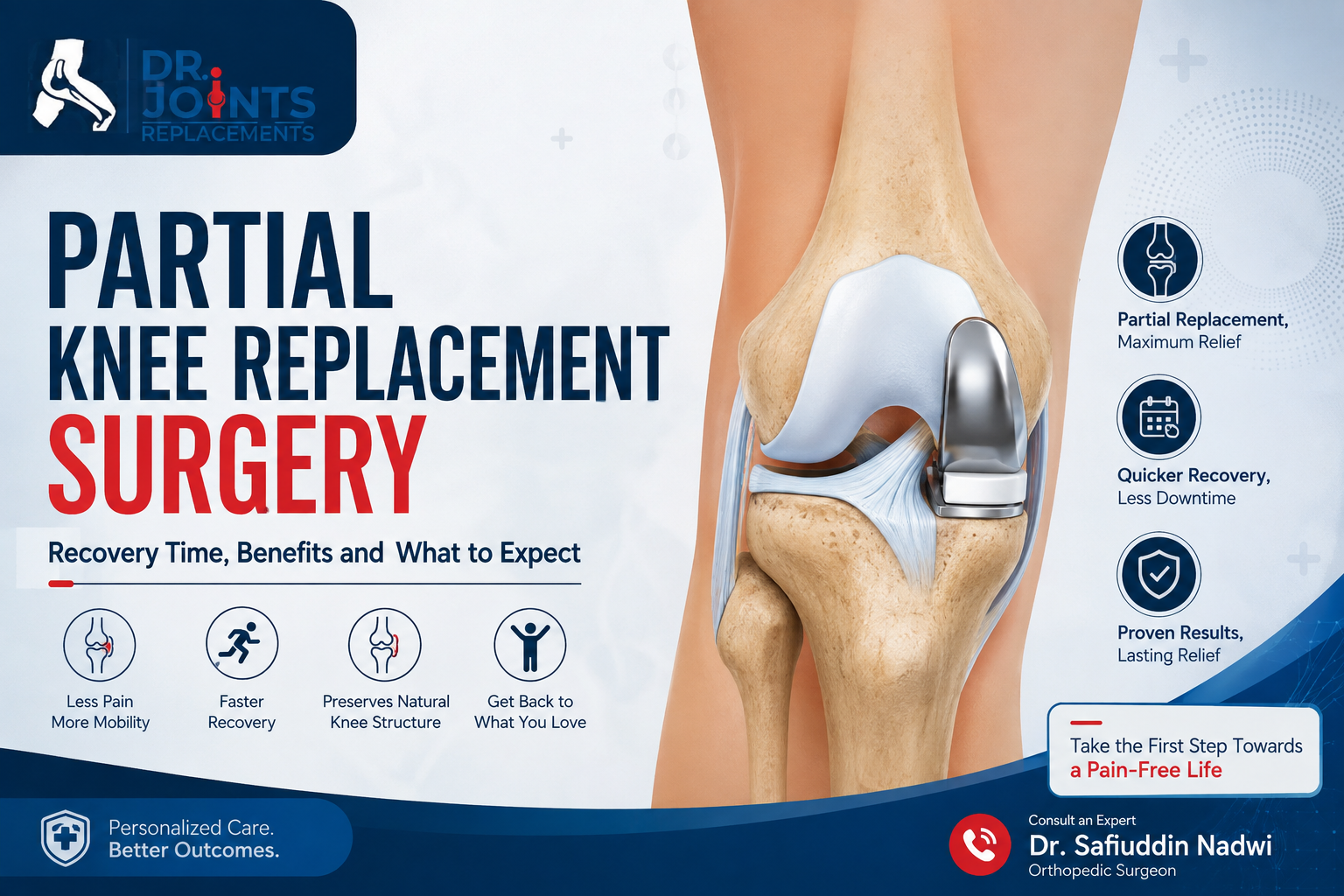
Think of the knee as having three sections: the medial side (inner), the lateral side (outer), and the patellofemoral area behind the kneecap. Arthritis doesn’t usually eat away at all three evenly. More often it settles into one spot while the rest holds up reasonably well.
When that’s what’s going on, a surgeon doesn’t need to replace the whole joint. They remove the worn surface in that one compartment and put in an implant there, and that’s it. The ligaments stay put. That’s actually a big part of why some patients say the knee feels more “theirs” afterward, compared to a full replacement.
Whether someone qualifies comes down to X-rays, a hands-on exam, and how the arthritis is distributed. Not every knee fits the criteria, and that’s fine, because it’s not meant to be a one-size-fits-all fix. Dr. Safiuddin Nadwi generally runs through this kind of assessment before deciding whether partial replacement makes sense or whether a different approach fits better. It’s less about picking the smaller surgery and more about picking the right one.
Who Actually Ends Up Being a Candidate
There’s no rigid checklist here, but a few patterns show up again and again in patients who end up going this route:
- Pain that’s mostly stuck in one part of the knee, not spread across the whole joint
- Physiotherapy, medication, or lifestyle changes that haven’t moved the needle much
- Ligaments that are still doing their job
- Scans that back up the idea that the damage is localized
Age doesn’t really decide this one way or the other. Two people in their sixties with near-identical symptoms could get completely different recommendations once their imaging comes back, simply because their arthritis sits in different places.
Why Patients (and Surgeons) Often Lean Toward This Option
There’s an obvious appeal to keeping more of your own knee. Since only the damaged part gets replaced, the healthy bone and ligament tissue never gets touched.
Recovery can also move faster, at least early on, since there’s less overall disruption to the joint compared to a total replacement. That’s not a promise, though; some people bounce back quicker than others regardless of which procedure they had.
Then there’s how the knee feels afterward. Patients who kept their original ligaments often say the movement feels closer to what it used to be, before arthritis got involved.
And of course, the whole point is pain relief and getting back to normal life without constantly babying one leg.
None of that guarantees a perfect outcome for everyone. It still comes down to whether someone was a good candidate in the first place, and whether they actually put in the work during rehab afterward.
What the Surgery Itself Involves
Before anything happens in the operating room, the surgeon goes through the patient’s history, checks the knee physically, and reviews imaging to pin down exactly where the damage is. During the surgery, the damaged surface comes out and an implant goes in, sized and positioned to fit that particular knee.
How exactly this is done depends on which compartment is affected and the surgeon’s own judgment call on the day. Afterward, the care team walks the patient through pain control, wound care, and when it’s safe to start moving the leg again.
Recovery: What the First Few Weeks Actually Look Like
Recovery tends to start faster than most people expect. Walking with support, sometimes within a day of surgery, is fairly standard, mostly because moving early helps avoid stiffness and speeds up healing overall.
Broadly, recovery involves managing pain and swelling early on, gradually building up how far you can walk, going through physiotherapy to rebuild strength and flexibility, and slowly working back toward your regular routine.
One thing worth saying plainly: it’s not a race. Comparing your recovery to a neighbor’s or a relative’s who had the same surgery usually just creates stress that doesn’t help anything.
So, How Long Does Recovery Actually Take?
There’s no single number that applies across the board, but here’s roughly how it tends to unfold.
In the first few days, the focus is mostly on controlling swelling and pain, along with some light movement under supervision. Over the following weeks, walking distance and knee flexibility usually improve steadily, with physiotherapy continuing the whole time.
By around four to six weeks, a lot of patients are back to handling most of their day-to-day activities, though this really depends on how healing is going and how consistent someone’s been with rehab. From there, strength, balance, and stamina keep building, sometimes for several months.
Some people move through this faster, others take longer, and both are normal. Age, general health, and how seriously someone takes their physiotherapy all factor in. Whatever your surgeon tells you about your own timeline matters more than any general guide, this one included.
Partial vs. Total: What’s the Real Difference
The short version: partial replacement deals with one damaged compartment, total replacement deals with the whole joint.
| Partial Knee Replacement | Total Knee Replacement |
| Treats one specific compartment | Treats damage across the joint |
| Keeps more of the natural bone and ligament | Replaces more of the joint surface |
| Recovery often faster in suitable cases | Usually needed for widespread arthritis |
| Only works when damage is localized | Works for more extensive damage |
This isn’t about choosing the “easier” surgery. It’s about matching the procedure to how much of the joint is actually damaged.
When It’s Worth Seeing an Orthopedic Surgeon
Persistent knee pain gets written off as “just getting older” a lot, but that’s not really a reason to ignore it. It’s worth getting checked out if you’re dealing with pain that doesn’t settle with rest, trouble on stairs or with distances you used to walk without a second thought, swelling that keeps coming back, pain that messes with your sleep, or just not seeing any real improvement from physiotherapy or medication.
An orthopedic evaluation can sort out whether the answer is medication, physiotherapy, an injection, or surgery, and if it’s surgery, which kind actually fits your knee.
Frequently Asked Questions
What is partial knee replacement surgery? A procedure that replaces only the damaged part of the knee while leaving the healthy bone and ligaments in place, used when arthritis is limited to one compartment.
How long does recovery take? It depends on the person. Many are handling everyday activities within a few weeks, though full strength and stamina can take several months to come back completely.
Is partial replacement better than total replacement? Not really, no. It depends entirely on how much of the knee is damaged and where that damage sits.
Can you walk soon after surgery? Usually, yes. Walking with support often starts within a day or two, depending on what the surgeon feels is appropriate.
Do you really need physiotherapy afterward? Yes, and it’s not optional in any meaningful sense. It’s a big part of getting strength, flexibility, and confidence back in the joint.
How does a surgeon figure out if someone qualifies? Through a physical exam, imaging, checking ligament stability, and looking at where the arthritis has actually spread.
Who should you talk to about this? An orthopedic surgeon experienced in joint replacement, someone like Dr. Safiuddin Nadwi, who can look at your knee specifically and tell you what fits.
Final Thoughts
Partial knee replacement surgery isn’t for every arthritic knee, but for the ones where the damage is genuinely localized, it can mean real pain relief and a quicker road back to normal life than a full replacement would offer. Knowing roughly what recovery looks like, and how long it tends to take, makes the whole process a little less unpredictable.
If knee pain has been getting in the way of things you’d rather be doing, talking to an orthopedic surgeon is really the only way to find out which option, partial replacement, total replacement, or something short of surgery altogether, actually makes sense for your knee.