Robotic Knee Replacement: 7 Factors That Decide If You Really Need It
Robotic knee replacement gets a lot of attention these days. Hospitals promote it, patients search for it, and many people now walk into a clinic already asking for it by name, sometimes before a doctor has even looked at their X-rays.
But not every patient with knee pain or arthritis needs robotic assistance. It’s a tool that helps surgeons plan and carry out knee replacement surgery with more precision in certain situations. That doesn’t make it the automatic right choice just because it sounds advanced.
This article walks through what robotic knee replacement actually involves, along with seven factors orthopedic specialists typically weigh before recommending it. The point is to help patients ask sharper questions at a consultation, not to replace one.
What Is Robotic Knee Replacement?
Robotic knee replacement, sometimes called robot assisted knee replacement, is a surgical approach where a robotic arm or guidance system assists the surgeon during knee replacement surgery. The surgeon stays in control the entire time. The robot doesn’t operate on its own.
Before surgery, a CT scan or X-ray is used to build a 3D model of the patient’s knee. That model helps the team plan implant size, positioning, and alignment for that specific joint. During surgery, the robotic arm helps guide bone cuts within the boundaries already set in the plan, while the surgeon continues making every clinical call along the way.
So robotic knee replacement treatment is really the surgeon’s judgment paired with a computer-assisted planning tool, not a machine performing surgery independently.
Robotic Knee Replacement vs Traditional Knee Replacement
Both are established forms of knee replacement treatment. The real difference is in how the planning and execution happen.
In traditional knee replacement, the surgeon relies on manual instruments, visual judgment, and experience to align and position the implant. Robotic knee replacement adds imaging-based planning and robotic guidance on top of that, working toward a more individualized surgical plan.
Neither one wins outright for every patient. Traditional knee replacement has decades of results behind it. Robotic assistance can help in specific knee conditions, but it’s one option among several, not a required upgrade.
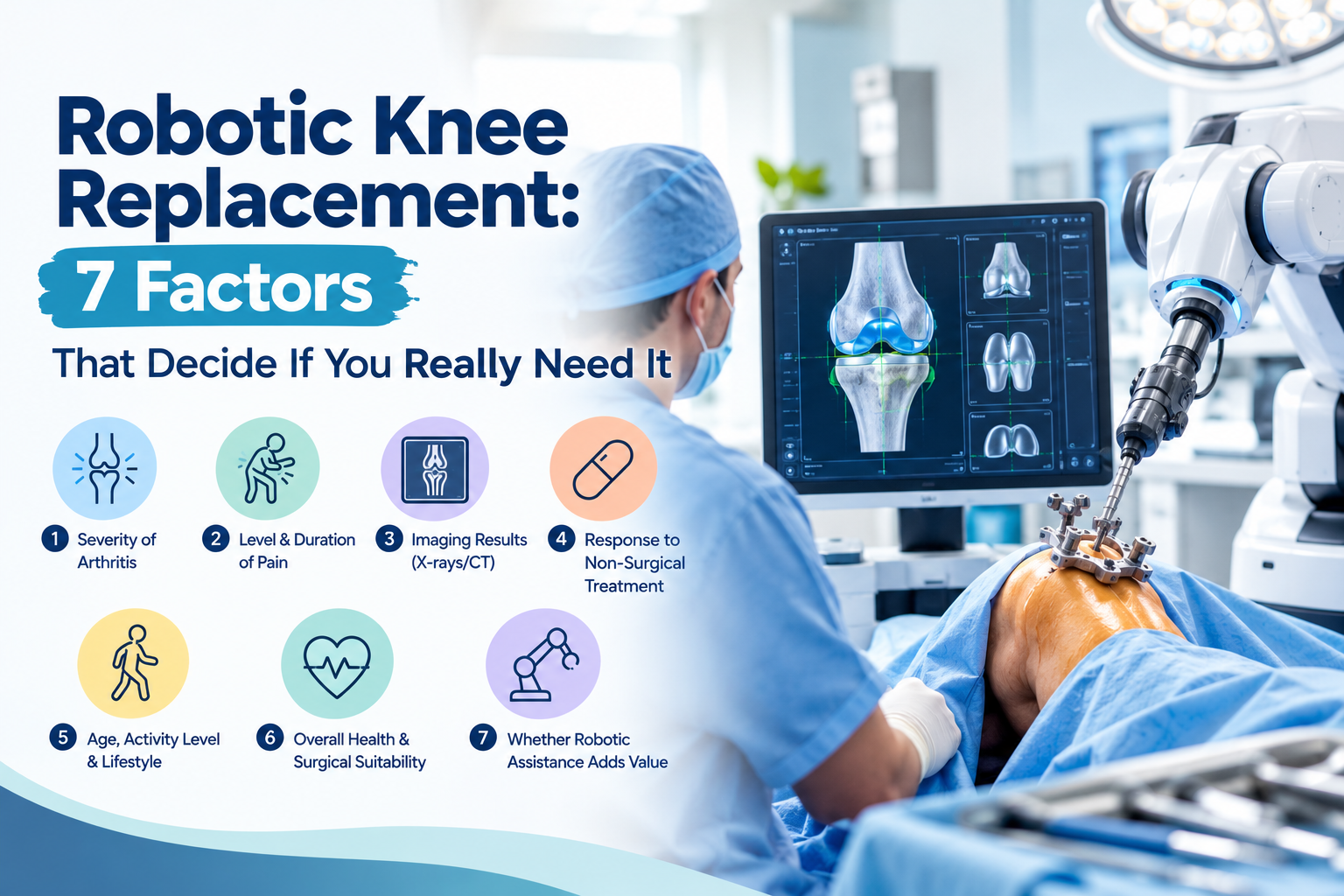
7 Factors That Help Determine If Robotic Knee Replacement May Be Suitable
1. Severity of Knee Arthritis
How far the arthritis has progressed matters a great deal. Early or moderate osteoarthritis is usually managed with medication, physiotherapy, weight management, and other lifestyle changes rather than any kind of surgery.
Robotic knee replacement, like other knee replacement surgery, generally comes up only once the joint surface is significantly damaged and non-surgical knee arthritis treatment stops giving meaningful relief.
2. Level and Duration of Knee Pain
Pain that’s been around for months or years and limits basic things like walking, climbing stairs, or standing up from a chair is a different situation from occasional discomfort. The latter usually doesn’t call for a conversation about knee replacement at all.
Specialists look at how well severe knee pain treatment has or hasn’t worked in the past before any surgical route enters the picture.
3. Damage Seen on X-rays or Other Imaging
Imaging gives the surgeon something concrete to work from. Cartilage loss, bone-on-bone contact, bone spurs, and narrowed joint space all factor into whether surgery makes sense, and which approach might fit.
This matters even more for robotic knee replacement surgery, since detailed imaging is exactly what feeds the 3D surgical plan mentioned earlier.
4. Response to Non-Surgical Knee Arthritis Treatment
Most orthopedic specialists want to see that conservative options have genuinely been tried first. Physiotherapy, anti-inflammatory medication, weight management, activity changes, and sometimes injections are usually part of that.
Once knee arthritis treatment through these methods stops controlling symptoms and daily function keeps slipping, surgery becomes a real conversation. Robotic assistance is one of the surgical paths that might come up then, not the starting point.
5. Age, Activity Level, and Daily Lifestyle
Age, activity level, and what someone expects from their knee day to day all shape the surgical plan. A younger, active patient and an older patient with different mobility goals often need different considerations around implant choice and technique.
This is part of why robotic knee replacement gets described as a personalized surgical tool. It can help tailor implant positioning to a patient’s own joint mechanics and movement, though the outcome still depends on plenty of other factors beyond the technology itself.
6. Overall Health and Suitability for Surgery
General health matters for any surgery, robotic knee surgery included. Uncontrolled diabetes, heart conditions, obesity, and other complicating factors need to be assessed, and ideally managed, before surgery is even scheduled.
A surgeon has to confirm a patient can safely handle anesthesia and the procedure itself before the conversation about robotic versus traditional technique even starts.
7. Whether Robotic Assistance Offers a Relevant Surgical Advantage for the Individual Patient
This last one is arguably the most important. The surgeon has to ask whether robotic guidance actually adds something for this particular knee. Complex deformity, unusual anatomy, or a need for very precise alignment are situations where robotic planning can genuinely help. In more straightforward cases, traditional knee replacement surgery may do the job just as well.
This is exactly why robotic knee replacement shouldn’t be treated as a blanket upgrade. It’s applied where it’s likely to add real value, not handed out by default.
When Is Knee Replacement Surgery Usually Considered?
Knee replacement, robotic or traditional, generally comes into the picture when a patient is dealing with:
- Severe, ongoing knee pain that disrupts sleep and daily life
- Real difficulty walking, climbing stairs, or standing for any length of time
- Stiffness or reduced mobility that limits normal movement
- Visible joint deformity, such as bowing of the leg
- Advanced arthritis confirmed through imaging
- Little to no lasting relief from non-surgical treatment, medication, or injections
Even with these signs present, whether to move ahead with surgery, and whether robotic assistance fits, is a call an orthopedic specialist makes after a full evaluation.
What Happens During a Robotic Knee Replacement Procedure?
Protocols vary a bit between hospitals, but a robotic knee replacement procedure generally follows this shape:
- Pre-surgical evaluation, including a physical exam and medical history review
- Imaging and 3D planning using CT scans or X-rays to map the joint
- Surgical plan creation, mapping implant size, position, and alignment virtually
- Robotic-assisted surgery, where the surgeon uses the system to guide precise bone preparation within the plan
- Implant placement, carried out and checked by the surgical team
- Immediate post-operative care, including pain management and early movement
- Structured rehabilitation to rebuild knee function and strength over time
Throughout all of this, the surgeon is the one performing the operation. The robotic system supports that work; it doesn’t take it over.
Benefits of Robotic Knee Replacement
Some potential robotic knee replacement benefits that come up often:
- More detailed pre-surgical planning built around the patient’s own anatomy
- Help achieving the planned implant alignment during surgery
- A surgical approach that can be adjusted to individual joint mechanics
These are potential advantages tied to planning and execution, not guarantees of pain relief, mobility, or long-term results. Outcomes in any knee replacement, robotic or otherwise, depend on the patient’s overall health, the surgical team’s skill, the implant used, and how closely rehabilitation is followed afterward.
Robotic Knee Replacement Recovery and Recovery Time
Robotic knee replacement recovery follows a path fairly similar to traditional knee replacement recovery. Most patients start gentle movement and physiotherapy within a day or two, with hospital stays and early mobilization guided by the surgical team.
Robotic knee replacement recovery time isn’t the same for everyone. What tends to move the needle:
- Age and general fitness going into surgery
- Any existing health conditions
- How closely rehabilitation instructions are actually followed
- Muscle strength and joint condition beforehand
- Individual healing response
Because of that variation, promising a fixed recovery timeline wouldn’t be honest. A surgeon and physiotherapist tracking progress after surgery are in a much better position to give an individual outlook.
Robotic Knee Replacement Cost
Robotic knee replacement cost, like robotic knee surgery cost generally, doesn’t come down to one number. It depends on things like:
- The hospital and city where the surgery happens
- The surgeon’s experience and fees
- Which robotic system is used
- The type and brand of implant
- Pre-surgical investigations and imaging
- Length of hospital stay
- Post-surgical physiotherapy and follow-up care
Since these vary from patient to patient and hospital to hospital, a real cost estimate only comes after a consultation and evaluation with the treating team.
Is Robotic Knee Replacement a Type of Knee Replacement Treatment?
Yes, it’s a form of knee replacement treatment, not a separate category on its own. The goal is the same as traditional knee replacement: remove damaged joint surfaces and replace them with an artificial implant to restore function and cut down on pain.
“Robotic” just describes the technology assisting with planning and precision during surgery. It sits alongside traditional and minimally invasive techniques within the broader field of advanced knee replacement treatment.
When Should You Consider Consulting an Orthopedic Specialist?
It’s generally worth booking a consultation when knee symptoms start getting in the way of daily life. That includes:
- Knee pain that’s stuck around for several weeks or months
- Pain that gets worse with walking, stairs, or standing
- Visible swelling, stiffness, or reduced range of motion
- Trouble doing everyday tasks because of the knee
- Little or no improvement despite rest, medication, or home care
A proper orthopedic evaluation, physical exam plus imaging, is really the only way to know whether the issue can still be managed conservatively or whether knee replacement, robotic or traditional, needs to be on the table.
Frequently Asked Questions
Is robotic knee replacement better than traditional knee replacement?
Not universally. Robotic knee replacement can offer more detailed surgical planning in certain cases, while traditional knee replacement has decades of proven results behind it. Which one fits depends on the individual knee and the surgeon’s assessment.
Who is a candidate for robotic knee replacement?
There’s no single profile that qualifies someone. It depends on arthritis severity, imaging findings, how the knee has responded to non-surgical treatment, overall health, and whether robotic guidance would actually help that specific joint. Only an orthopedic specialist can confirm this after an evaluation.
What is the recovery time after robotic knee replacement?
It varies by patient, largely based on age, fitness, health conditions, and how closely rehabilitation is followed. There’s no single timeline that applies across the board.
How much does robotic knee replacement cost?
Cost depends on the hospital, surgeon, robotic system, implant, city, and related treatment expenses. A precise figure only comes after a consultation and evaluation.
Is robotic knee replacement suitable for severe knee arthritis?
It can be, in cases where imaging and clinical assessment support it, but that’s decided individually rather than assumed for every severe case.
Can knee arthritis be treated without replacement?
Yes. Plenty of cases are managed for years through physiotherapy, medication, weight management, activity changes, and injections before surgery even enters the conversation.
Is robotic knee replacement safe?
Like any surgical procedure, it carries risks that vary from patient to patient. Safety and suitability get assessed individually by the treating orthopedic surgeon.
Conclusion
Robotic knee replacement is a real advancement in orthopedic surgery, but it isn’t the automatic answer for everyone dealing with knee pain or arthritis. Whether it’s a fit depends on arthritis severity, imaging results, how prior treatment worked, age, activity level, general health, and whether the technology offers a real advantage for that particular knee.
Anyone dealing with persistent knee pain, stiffness, or trouble moving around should think about consulting an orthopedic specialist for a proper evaluation. Only a detailed clinical assessment, backed by imaging, can say whether conservative treatment, traditional knee replacement, or robotic knee replacement is the right path.