
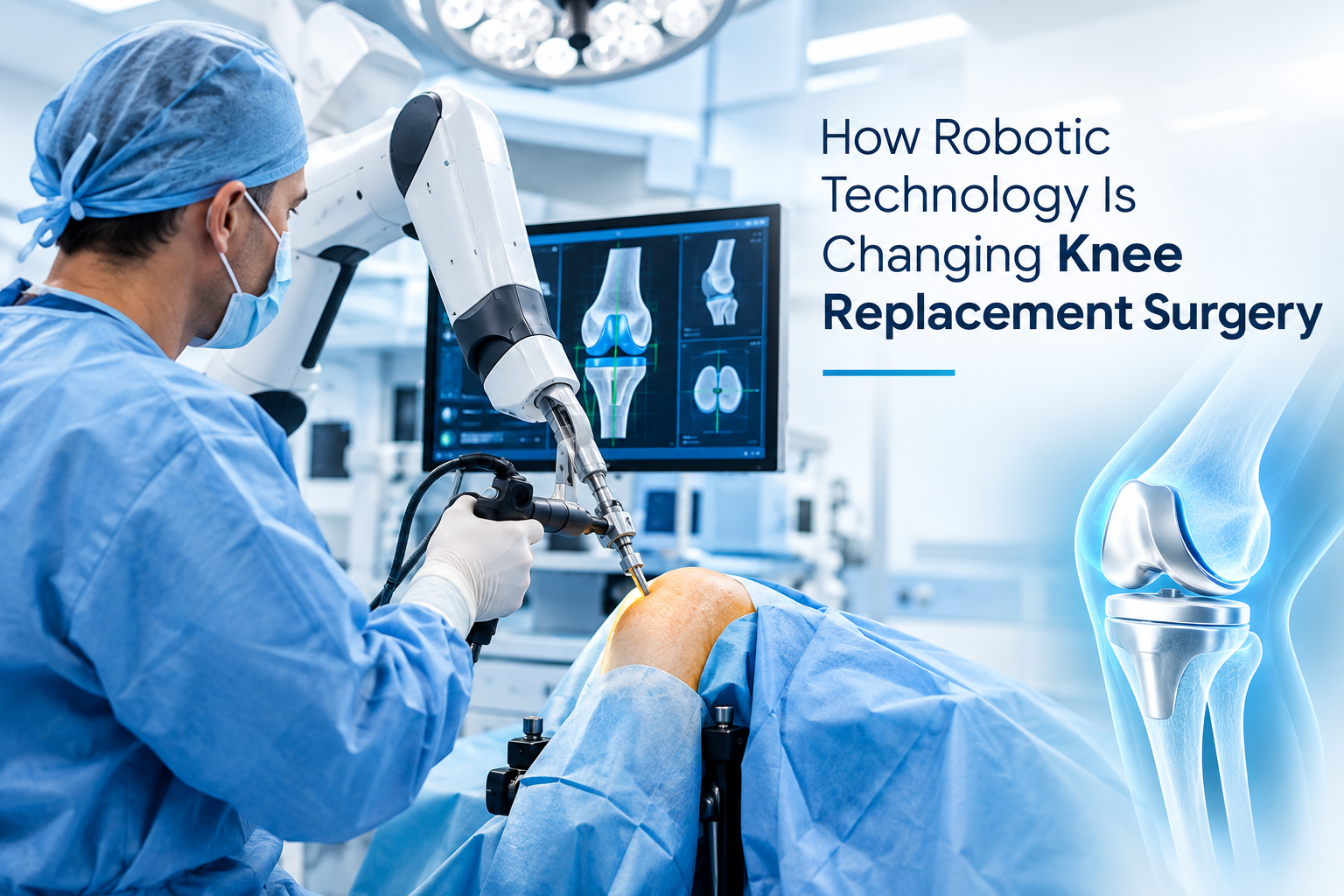
How Robotic Technology Is Changing Knee Replacement Surgery
Knee replacement surgery has changed a lot over the past decade, mostly because of one thing: technology. Robotic-assisted systems, once experimental, are now something patients actively ask about before choosing a surgeon.
If you’ve been researching knee replacement, you’ve probably run into terms like robotic knee replacement and wondered what they actually mean in practice. It’s a fair question. The short answer is that robotic assistance changes how surgery is planned and executed, though it doesn’t change what the surgery is trying to achieve.
What Is Robotic Knee Replacement?
Robotic knee replacement surgery uses a robotic-arm system to assist the orthopedic surgeon during the operation. That word “assist” matters. The robot doesn’t operate on its own, and it isn’t making decisions.
The surgeon still plans the case, still holds the instruments, and still makes every call during surgery. What robotic knee surgery adds is a layer of data and mechanical guidance the surgeon can lean on while doing that work.
Put simply, a robot assisted knee replacement gives the surgeon more information at each step. The judgment and skill required haven’t gone anywhere.
How Robotic Technology Works During Knee Replacement
Pre-Surgical Planning
Before surgery, imaging of the patient’s knee is used to build a plan specific to that person’s anatomy. This happens well before the patient is in the operating room.
3D Imaging and Digital Mapping
Most robotic assisted knee replacement systems build a 3D model of the knee from this imaging. The surgeon can look at the joint from angles that wouldn’t otherwise be possible before making a single cut.
Surgical Navigation
Once surgery starts, the system tracks positioning in real time and compares it against the plan made earlier.
Bone Preparation
The robotic system helps keep bone preparation within the boundaries set during planning, giving the surgeon a check as they work.
Implant Positioning and Alignment
Implant positioning is where this technology gets discussed most. The system helps the surgeon align the implant to match the patient’s own joint mechanics, rather than a generic template.
How Robotic Technology Is Changing Knee Replacement Surgery
Surgical planning has become more individual. Because these systems work from a patient’s own imaging, the plan reflects that person’s anatomy instead of average measurements. This is part of what people mean by personalized knee replacement.
Bone preparation benefits from the same shift. Real-time feedback during this step helps the surgeon stay closer to what was planned.
Implant alignment gets extra support too. The system gives the surgeon reference points during placement that weren’t available with older methods.
Guidance during the operation itself is arguably the biggest change. Surgeons can adjust mid-procedure based on live feedback, not just pre-operative estimates. That’s a meaningful shift from how knee surgery used to work.
None of this guarantees a particular outcome. But combining detailed planning with live feedback does support more consistent execution of the surgical plan across cases.
Benefits of Robotic Knee Replacement
People usually ask about the benefits of robotic knee replacement in terms of the process, not promised results. And that’s the right way to think about it. The advantages tend to show up as more detailed planning, more data during surgery, and a more structured approach to bone preparation.
That said, the benefits of robotic knee surgery aren’t automatic. They depend on the surgeon’s experience, the patient’s health, and which robotic system is used. No technology, robotic or otherwise, can promise a specific result. That’s a conversation to have directly with an orthopedic surgeon.
Robotic Knee Replacement Accuracy: What Patients Should Know
Robotic knee replacement accuracy describes how closely the actual surgery matches the plan built beforehand, using imaging, mapping, and real-time feedback to support that match.
But accuracy isn’t the same as guaranteed precision. Robotic knee surgery accuracy still depends on bone quality, soft tissue balance, and the surgeon’s own technique. The robot supports the surgeon’s precision. It doesn’t replace judgment, and it can’t promise the same outcome for every patient.
Robotic Knee Replacement Procedure
Every hospital does things a little differently, but a robotic knee replacement procedure generally follows this sequence:
- Initial evaluation: the surgeon reviews the patient’s knee condition, history, and general fitness for surgery.
- Imaging and planning: scans build a digital model of the knee, which becomes the basis for a personalized plan.
- Surgery preparation: on the day itself, that plan is loaded into the robotic system and adjusted to match the patient’s actual anatomy.
- Bone preparation and implant placement: the surgeon uses the robotic arm as a guide while shaping bone and placing the implant.
- Closure and recovery: once alignment is confirmed, the incision is closed and the patient moves to recovery for monitoring.
The surgeon runs every step. The robot is there to support that work, not take it over.
Robotic Knee Replacement Recovery Time
There’s no single number for robotic knee replacement recovery time. It depends on the patient’s age, general health, how active they were before surgery, and how well they stick to post-operative instructions.
Most patients start gentle movement fairly soon after surgery, under medical supervision. Physiotherapy follows, and it does a lot of the heavy lifting in restoring strength and range of motion. Follow-up visits let the surgical team catch problems early.
Daily activities come back gradually, in stages set by the surgeon rather than a calendar. Robotic knee surgery recovery looks different for everyone, and comparing your own progress to someone else’s case isn’t especially useful. Sticking to the rehabilitation plan matters more than the calendar does.
Is Robotic Knee Replacement Suitable for Everyone?
No, not automatically. Whether robotic knee replacement makes sense depends on how severe the joint damage is, the patient’s age and bone quality, any existing medical conditions, and whether the same knee has been operated on before.
An orthopedic surgeon looks at all of this during consultation and decides whether a robotic approach, a traditional one, or something else entirely fits that particular patient.
Robotic vs Traditional Knee Replacement
The comparison mostly comes down to the tools used for planning and execution, not one method being better across the board.
| Aspect | Traditional Knee Replacement | Robotic Knee Replacement |
| Planning | Standard measurements and surgeon experience | 3D imaging and personalized digital planning |
| Navigation | Manual instruments, surgeon’s judgment | Real-time robotic navigation |
| Bone Preparation | Conventional instruments, manual technique | Guided within planned boundaries |
| Implant Positioning | Surgeon’s manual assessment | Robotic-assisted alignment data |
Skill and experience matter either way. Robotic assistance adds planning and guidance tools on top of that, but it doesn’t replace what the surgeon brings to the table.
Conclusion
Robotic technology is changing how knee replacement is planned and carried out, giving surgeons more tools for personalized planning, bone preparation, and implant positioning. It supports precision, but it works alongside the surgeon’s skill, not instead of it.
Every knee is different, and so is every patient’s situation. The best way to figure out which approach fits is a direct conversation with a qualified orthopedic surgeon.
Have questions about robotic knee replacement or want to know if it’s right for you? Book a consultation with our orthopedic team today.
Frequently Asked Questions
1. Is robotic knee replacement surgery painful?
Some discomfort is normal during recovery, as with any surgery. Pain management helps, but no procedure is entirely painless.
2. How is robotic knee surgery different from regular knee replacement?
The goal is the same: replacing a damaged joint. The difference is in the planning and guidance tools, with robotic systems adding 3D imaging and real-time navigation.
3. Does robotic assistance guarantee better results than traditional surgery?
No. It’s a tool that can support planning and precision, but results depend on several factors and aren’t guaranteed to be better.
4. How long does it take to recover from robotic knee replacement?
It varies by person, based on age, health, and how closely physiotherapy is followed. There’s no fixed timeline.
5. Who should I talk to about whether robotic knee replacement is right for me?
An orthopedic surgeon who works with both traditional and robotic-assisted methods can look at your case and recommend the right approach.