Partial vs Total Knee Replacement: How Do Doctors Decide?
If you have been living with knee pain for months or years, you have probably heard about knee replacement surgery as a way to get your life back. But there is a question that confuses most patients before their first consultation: should it be a partial knee replacement or a total knee replacement? This question, often searched as partial vs total knee replacement, sits at the heart of every knee arthritis consultation.
The truth is, there is no single test that gives a yes or no answer. Orthopedic surgeons look at your knee as a whole. They study your X-rays, examine your joint by hand, ask about your daily activities, and consider how your knee has responded to treatment so far. Only after putting all of this together can a surgeon recommend the knee replacement option that fits your specific knee.
This article explains how doctors actually make this decision, in plain language, so you can understand what your surgeon is looking for during your own evaluation.
Knee Replacement Is Not a One-Size-Fits-All Treatment
Knee arthritis does not look the same in every patient. Some people have damage in just one part of the knee. Others have arthritis spread across the entire joint. Because of this, knee replacement surgery is not a single fixed procedure. It is a group of surgical options, and the right one depends on what is actually happening inside your knee.
When people search for knee replacement options, they usually find two main paths: partial knee replacement and total knee replacement. Both aim to relieve pain and restore movement, but they are built for different situations. Neither one is automatically better. What works well for one patient’s knee may not be the right choice for another, even if both patients describe similar pain.
Understanding Knee Compartments
To understand the difference between partial and total knee replacement, it helps to know that the knee joint has three compartments, or sections.
The knee is not one flat surface. Think of it as three separate zones that can each wear out on their own. The medial compartment sits on the inner side of the knee, the lateral compartment is on the outer side, and the patellofemoral compartment is where the kneecap meets the thighbone.
Arthritis can affect just one of these areas, two of them, or all three. This is one of the first things your orthopedic surgeon checks, because it shapes almost every decision that follows.
- Medial compartment arthritis is the most common pattern of one compartment knee arthritis, since the inner side of the knee tends to bear more weight during walking.
- Lateral compartment arthritis affects the outer side and is less common.
- Patellofemoral arthritis involves the joint behind the kneecap and can cause pain that is worse on stairs or when standing up from a chair.
When arthritis stays limited to one compartment, a partial replacement may be possible. When multiple compartment knee arthritis is present, meaning two or three areas are damaged, a total replacement usually becomes the more suitable option.
What Is Partial Knee Replacement?
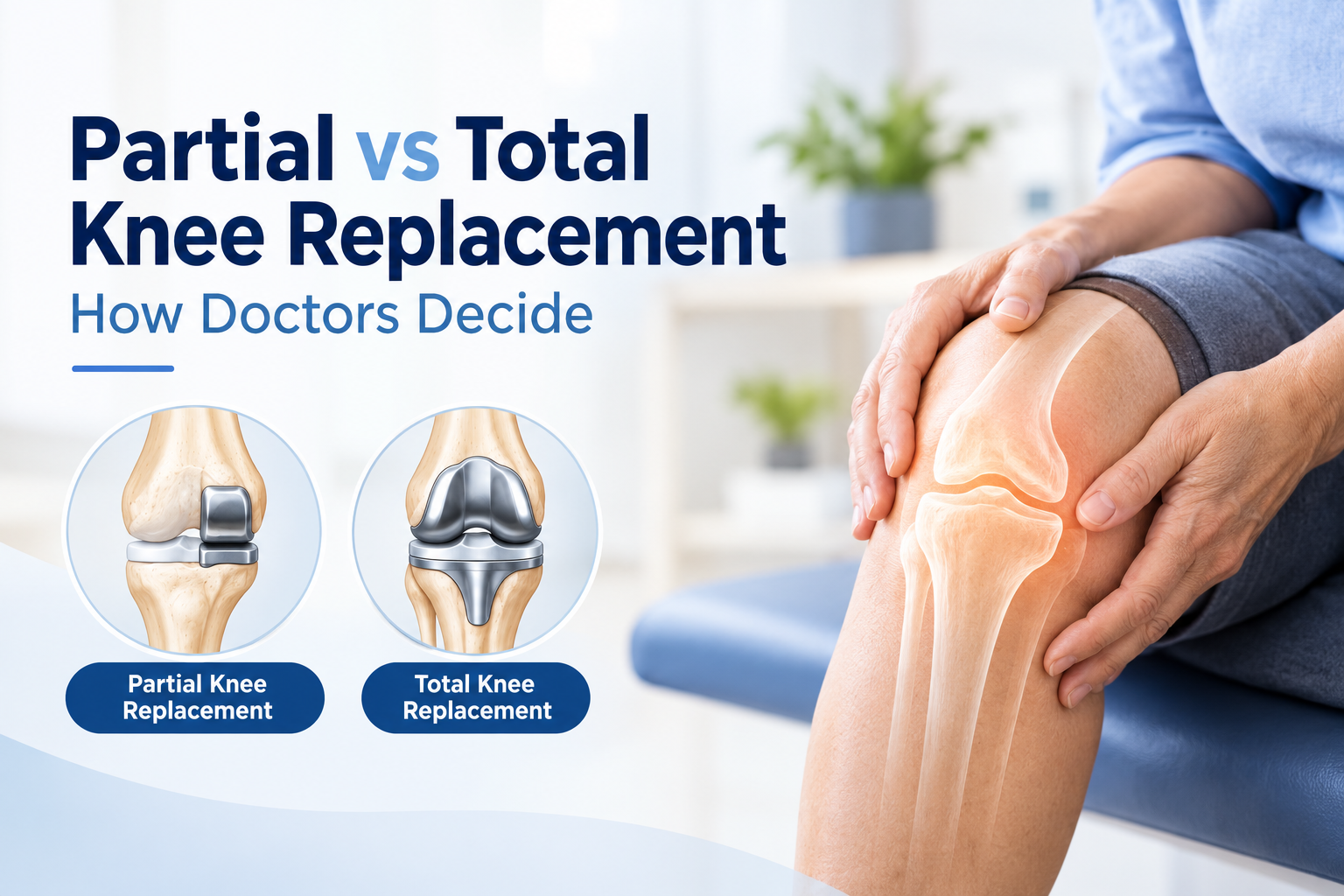
Partial knee replacement, also called unicompartmental knee replacement or knee resurfacing, treats only the damaged part of the knee. If your arthritis is confined to the medial or lateral compartment, or sometimes the patellofemoral compartment alone, your surgeon may resurface just that area while leaving the rest of your natural knee, including healthy cartilage, bone and ligaments, untouched.
Because less of the joint is disturbed, partial knee replacement is considered less invasive than a full joint replacement. Many patients describe the resulting knee as feeling closer to their natural joint, since more of their own anatomy is preserved. This bone-conserving approach is central to our Knee Resurfacing and Partial Knee Replacement program in Tardeo, Mumbai.
What Is Total Knee Replacement?
Total knee replacement resurfaces all three compartments of the knee. The damaged cartilage and bone across the joint are removed and capped with smooth artificial components, which recreate a stable surface for the femur, tibia and kneecap to move against.
This is the more commonly performed knee replacement procedure, mainly because most patients who reach the point of needing surgery already have arthritis spread across more than one part of the knee. Total knee replacement is generally the recommended path when damage is widespread, when ligaments are unstable, or when there is significant knee deformity that a partial replacement cannot correct. You can read more about this procedure on our Primary Knee Replacement page.
How Do Doctors Decide Between Partial and Total Knee Replacement?
This is the central question most patients want answered, and it deserves a clear explanation. This knee replacement decision is not based on one factor alone. Orthopedic surgeons build a full picture of your knee through a structured knee replacement evaluation that combines imaging, physical examination and your personal history. Here is what actually goes into that evaluation.
1. Location and Extent of Arthritis
The first and most important factor is where the arthritis is and how far it has spread. If only one compartment shows advanced cartilage damage on imaging, and the rest of the knee looks healthy, a partial knee replacement may be considered. If two or three compartments show significant wear, a total knee replacement is usually the safer, longer-lasting choice.
2. Severity of Cartilage Damage
Surgeons look closely at how much knee cartilage damage is present. Mild to moderate wear in a compartment that still has some cushioning may be managed with non-surgical care or knee preservation techniques. Once damaged knee cartilage becomes severe, bone can start rubbing against bone, and this is when knee replacement is typically discussed.
3. X-Ray Findings
Standing X-rays are one of the most useful tools in this decision. They show the narrowing of joint space, which reflects how much cartilage has been lost, and reveal whether the damage sits in one compartment or several. In some cases, additional imaging such as an MRI may be used to check the condition of ligaments and cartilage in more detail. X-rays also help the surgeon assess knee alignment, which plays a direct role in choosing between partial and total knee replacement.
4. Ligament Condition and Knee Stability
Knee ligament health matters more than many patients realize. A partial knee replacement generally requires the anterior cruciate ligament, and often the other supporting ligaments, to be intact and functioning well. If a patient has an untreated ligament tear or general knee stability problems, a partial replacement is less likely to hold up over time, and total knee replacement becomes the more dependable option. Good knee ligament stability supports the joint after surgery, so surgeons check this carefully during the physical exam.
5. Knee Alignment and Deformity
Some knees develop a bowlegged or knock-kneed appearance as arthritis progresses. Mild, correctable deformity may still allow for a partial replacement. Significant or fixed knee deformity usually points toward total knee replacement, since it addresses the entire joint and allows the surgeon to restore more balanced alignment.
6. Knee Range of Motion and Stiffness
Surgeons test how far the knee bends and straightens. A knee with reasonable knee range of motion and only mild knee stiffness may be suitable for a partial replacement. A knee with significant stiffness or a fixed flexion contracture, where the knee cannot fully straighten, often needs the more comprehensive correction that total knee replacement provides.
7. Pain Pattern
Knee pain that is clearly localized to one side of the knee, such as only the inner side, supports the idea of one compartment knee arthritis. Chronic knee pain that is spread across the whole joint, or that changes location, points toward wider arthritis and often favors total knee replacement.
8. Physical Examination
Beyond imaging, a hands-on exam tells the surgeon a great deal. This includes checking joint line tenderness, testing ligament stability, assessing muscle strength around the knee and observing how the patient walks. This step often confirms or adjusts what the X-rays suggest.
9. Previous Treatment Response
Doctors also consider how the knee has responded to earlier treatments like physiotherapy, medications or injections. If these measures gave only short-term relief and the arthritis keeps progressing, it may indicate more advanced joint damage, which can shift the decision toward total knee replacement.
10. Activity Level and Daily Needs
Your lifestyle matters. Someone who wants to return to walking long distances, gardening or moderate sports may benefit from the more natural movement that a partial replacement can offer, if their arthritis pattern allows it. Someone with more sedentary needs or multiple compartments affected will usually be guided toward total knee replacement regardless of activity level.
11. Overall Knee Condition and Treatment Goals
Finally, the surgeon puts all of this together with your personal goals. Two patients with similar X-rays might still receive different recommendations, because their pain levels, activity goals and general health are not the same. This is why the decision is described as individualized rather than formula-based.
Why Age Alone Does Not Decide the Procedure
Many patients assume that partial knee replacement is only for younger people and total knee replacement is only for older adults. This is not accurate. Age is one small piece of the picture, not the deciding factor. A fit, active person in their seventies with arthritis limited to one compartment may still be a good candidate for a partial replacement. Meanwhile, a younger patient with arthritis spread across the whole joint will usually need a total knee replacement. What matters most is the actual condition of the knee, not the number of birthdays behind it.
Partial Knee Replacement vs Total Knee Replacement: Key Differences
Understanding the partial knee replacement vs total knee replacement comparison, and the broader difference between partial and total knee replacement, can help you ask better questions during your consultation.
Partial knee replacement treats only the damaged compartment, preserves more natural bone and ligament tissue, involves a smaller incision, and is generally associated with a quicker return to daily activity for patients who qualify. This reflects the main partial knee replacement benefits. It is not suitable for every knee, since it depends on healthy ligaments and arthritis being confined to one area, which is one of the key partial knee replacement risks to discuss with your surgeon.
Total knee replacement treats the entire joint surface, corrects larger deformities and instability, and is the more predictable option when arthritis has spread through the knee. These are among the core total knee replacement benefits. It involves a larger procedure and typically a longer initial recovery period compared with a partial replacement, which is one of the total knee replacement risks patients should weigh, but it addresses damage that a partial replacement cannot reach.
Neither procedure is “better” in a general sense when people ask which knee replacement is better or is partial knee replacement better than total. Each is built to solve a different problem, and the right choice depends entirely on your knee’s condition.
Who Is a Candidate for Partial Knee Replacement?
This question, often typed as who qualifies for partial knee replacement or who is a candidate for partial knee replacement, comes up in almost every consultation. A typical partial knee replacement candidate has arthritis limited to one compartment, usually the medial compartment, along with:
- Intact and functioning knee ligaments, particularly the ACL
- Good knee range of motion without severe stiffness
- Minimal or correctable knee deformity
- No signs of inflammatory arthritis such as rheumatoid arthritis, since this tends to affect the whole joint rather than one section
- Pain that is clearly localized rather than spread across the knee
This covers the essential partial knee replacement eligibility and partial knee replacement indications that surgeons look for. Not every patient who wants a partial replacement will qualify. Your surgeon will confirm eligibility through imaging and a physical exam, since choosing the right candidate is one of the most important factors in a partial knee replacement surgery lasting well over time.
Who Should Consider Total Knee Replacement?
A typical total knee replacement candidate, and someone who often asks who should get total knee replacement, generally has:
- Arthritis affecting two or three compartments of the knee, known as multiple compartment knee arthritis
- Significant cartilage loss across the joint
- Noticeable knee deformity or instability
- Ligament damage that would make a partial replacement unreliable
- Advanced knee arthritis and severe knee arthritis that has not responded well to non-surgical care
This outlines the general total knee replacement eligibility and total knee replacement indications surgeons consider. Since most patients who reach the point of needing surgery have widespread joint damage, total knee replacement surgery remains the more commonly performed of the two procedures.
Can a Partial Knee Replacement Later Become a Total Replacement?
This is a common and fair question. If arthritis develops in another part of the knee after a partial replacement, or if the implant wears down over time, a total knee replacement can be performed later as a revision procedure. This possibility is part of what your surgeon weighs during the initial evaluation, along with your age, activity level and how many years of use are expected from the implant. It is one more reason why patient selection for partial knee replacement is done carefully rather than based on preference alone.
Comparing Recovery: Partial vs Total Knee Replacement
Patients often want to know how the partial knee replacement vs total knee replacement recovery experience differs between the two procedures. It is helpful to understand this in general terms, without expecting a fixed timeline, since every patient heals differently.
Partial knee replacement recovery, or recovery after partial knee replacement, is generally quicker in the early weeks, since the surgery is less invasive and involves less disruption to surrounding tissue. Many patients are walking with support soon after surgery and can resume light daily activities within a few weeks, though full recovery still takes time and consistent rehabilitation.
Total knee replacement recovery, or recovery after total knee replacement, tends to take longer in the initial phase, since the entire joint surface has been resurfaced. Physical therapy plays a central role in regaining strength and motion, and most patients see steady improvement over the following weeks and months.
Knee replacement recovery time depends on several things beyond the type of surgery itself, including your general health, how closely you follow your rehabilitation plan, your body weight, and the physical demands of your work and daily routine. Your surgeon and physiotherapy team will guide you through a plan suited to your situation rather than a generic timeline.
Long-Term Considerations
Both partial and total knee replacement are established, well-studied procedures with long track records in orthopedic surgery. Partial knee replacement long term results and total knee replacement long term results both depend on factors like implant type, surgical precision, patient selection and how well rehabilitation is followed.
One point worth understanding is that partial knee replacements can sometimes require further surgery down the line if arthritis progresses in another compartment or the implant wears out, while total knee replacement addresses the whole joint from the start. This does not mean one procedure is inferior. It simply reflects the different roles each surgery is designed to play. Your surgeon will discuss these long-term considerations with you as part of a complete knee replacement evaluation.
Knee Replacement Surgery Cost
Many patients want a clear number when it comes to knee replacement surgery cost, but this is genuinely difficult to state as a fixed figure, because it depends on several variables. Partial knee replacement cost and total knee replacement cost can differ based on:
- The specific procedure performed and its complexity
- The type of implant used
- The hospital and facility fees involved
- The surgeon’s experience and technique, including whether robotic assistance is used
- Pre-surgery tests and imaging
- Length of hospital stay
- Post-surgery rehabilitation and physiotherapy needs
- Any additional care required based on your individual health
Because these factors vary from patient to patient, the most reliable way to understand your knee replacement surgery cost is through a personal knee replacement consultation, where your surgeon can review your case and outline what to expect.
What Tests Are Needed Before Knee Replacement?
Before recommending partial or total knee replacement, your orthopedic surgeon will typically request standing X-rays to assess joint space narrowing, alignment and deformity. Depending on your case, an MRI may be used to evaluate cartilage and ligament condition in more detail. Blood tests and a general health check are also common, to make sure you are fit for surgery and anesthesia. This full knee replacement evaluation ensures the decision is based on solid, current information about your joint rather than guesswork.
Making the Decision With Your Orthopedic Surgeon
If you are weighing partial or total knee replacement, the most useful step is a proper consultation with an orthopedic surgeon who can examine your knee, review your imaging and discuss your goals directly. Reading about knee arthritis treatment and knee arthritis surgery options online is a good starting point, but only a hands-on evaluation can confirm which option truly fits your knee.
Dr. Safiuddin Nadwi, a robotic joint replacement surgeon and orthopedic knee surgeon practicing in Tardeo, Mumbai, works as a dedicated knee arthritis specialist and knee replacement specialist, evaluating each patient’s arthritis pattern, ligament health, alignment and daily activity needs before recommending a surgical plan. This kind of individualized knee replacement evaluation is central to choosing between partial and total knee replacement with confidence.
Frequently Asked Questions
Which knee replacement is better, partial or total? This is the most common way patients ask which is better partial or total knee replacement. Neither is better in general. The right choice depends on how much of your knee is affected by arthritis, the condition of your ligaments, and your overall knee health. Your surgeon will guide you based on your specific case.
Am I a candidate for partial knee replacement, and can I have partial knee replacement? You may be a candidate if your arthritis is limited to one compartment, your ligaments are intact and stable, and your knee has good range of motion without major deformity. This can only be confirmed through an examination and imaging.
When is total knee replacement recommended, and when is partial knee replacement recommended? Total knee replacement is typically recommended when arthritis affects multiple compartments of the knee, when there is significant deformity or ligament instability, or when a partial replacement would not provide lasting relief. Partial knee replacement is usually recommended when damage stays confined to one compartment with healthy ligaments and good alignment.
Does my age matter in this decision, and what factors determine knee replacement type? Age plays a small role but does not decide the procedure on its own. The factors that determine knee replacement type include arthritis location, ligament health, alignment, cartilage damage and your activity goals.
Will partial knee replacement recovery be faster than total knee replacement recovery, and how long is recovery after each procedure? Many patients experience a quicker initial recovery after partial knee replacement, since it is less invasive. However, actual recovery time still depends on your health, rehabilitation and daily activity demands, for both how long is recovery after partial knee replacement and how long is recovery after total knee replacement.
Can partial knee replacement be converted to total knee replacement later, and how long does each option last? Yes, if arthritis develops elsewhere in the knee or the implant wears down over time, a total knee replacement can be performed as a later procedure. Questions like how long does partial knee replacement last and how long does total knee replacement last are best answered by your surgeon, since implant life depends on individual factors.
Can arthritis in one compartment be treated with partial knee replacement, and what happens if arthritis affects the whole knee? Yes, arthritis confined to one compartment is the main reason partial knee replacement becomes an option. If arthritis affects the whole knee, across multiple compartments, total knee replacement is generally the more suitable path.
A Final Word
Choosing between partial and total knee replacement is not something you need to figure out alone. It comes down to a careful look at your arthritis pattern, cartilage damage, ligament health, alignment and daily needs, brought together by an experienced orthopedic surgeon for knee replacement. If chronic knee pain is affecting your daily life, the most helpful next step is a consultation where your knee can be properly evaluated and your options explained clearly. This is really how to choose between partial and total knee replacement: not by guessing, but by letting a full clinical picture guide the decision.