
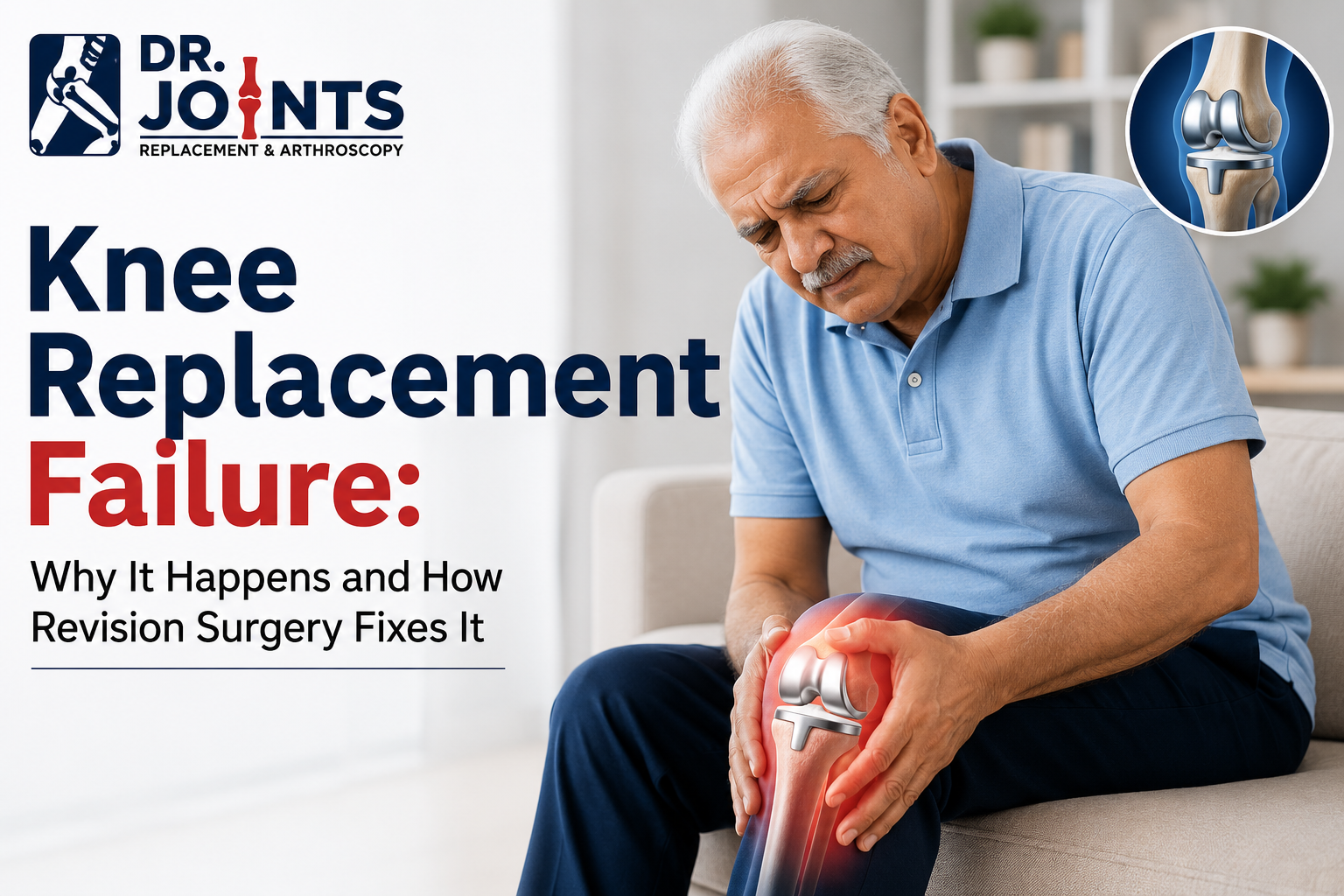
Knee Replacement Failure: Why It Happens and How Revision Surgery Fixes It
You had the surgery. You did the physiotherapy. For a while, things were better. Then the pain came back.
Maybe it crept in slowly over a few months. Maybe it returned one morning and simply never left. Your knee is swelling again. Bending it feels wrong. Sometimes it feels unsteady, like it might give way without warning.
This is one of the most distressing experiences a patient can go through, because nobody told you this could happen. You did everything right. And yet here you are, back where you started, or worse.
What you are experiencing has a name: knee replacement failure. It affects thousands of patients across India every year. And the most important thing to understand right now is that it can be fixed.
The procedure that fixes it is called revision knee replacement surgery. When it is performed by a specialist who truly understands this complex operation, most patients get their mobility, comfort, and quality of life back. But the first step is understanding what went wrong and why.
How Long Does a Knee Replacement Last?
Patients are usually told their implant will last 15 to 20 years. That is a reasonable average. But it is just that, an average. Some implants function well for 25 years. Others begin failing within 2 to 3 years. A small number of patients experience problems within months of surgery.
How long a knee replacement lasts depends on your body weight, activity level, bone quality, the implant design used, and critically, the accuracy of the surgical technique. Even a technically correct surgery can lead to early failure if the implant alignment is even slightly off.
This is not about blame. It is about understanding that a failed knee replacement is a medical problem that has a medical solution.
Why Does Knee Replacement Fail? The 7 Real Causes
1. Implant Loosening
Knee replacement loosening is the single most common reason patients need a second surgery. When an implant loosens, the bond between the metal components and your bone breaks down. Every step then creates tiny movements at that junction. Bone gradually erodes. Pain builds.
Patients with loosening typically describe a deep, grinding ache that is worse when standing or walking and slightly better when sitting still. Some notice it first on stairs. Others feel it as a general heaviness that never fully goes away. X-rays can sometimes show the gap between the implant and bone, though early loosening is subtle and a bone scan is often needed for a clear diagnosis.
Loosening can happen because of natural wear, excessive body weight putting stress on the bone interface, or because tiny particles shed by the plastic spacer trigger an inflammatory reaction that slowly dissolves surrounding bone. This second process is called osteolysis and it happens silently for years before symptoms become obvious.
2. Periprosthetic Joint Infection (PJI)
Periprosthetic joint infection is among the most serious of all knee replacement complications, and it is also one of the most frequently missed in India. Many patients with PJI spend months being told their pain is normal, or being given painkillers and physiotherapy, when what they actually need is urgent surgical treatment.
Bacteria can enter the knee joint during the original surgery, or they can travel through the bloodstream from somewhere else in the body entirely, even years later. A dental procedure, a urinary infection, a skin wound, or any source of bacteria in your body can seed the implant. Once bacteria form what is called a biofilm on the metal surface, antibiotics alone cannot clear them. The infection quietly eats away at surrounding bone and causes persistent pain, swelling, and warmth.
Signs that your knee may be infected:
- The knee feels warm or hot to the touch, not just after activity but all the time
- Swelling that arrived suddenly or has been getting worse for weeks
- Fever or feeling generally unwell without another explanation
- Redness around your old surgical scar
- Pain that is constant rather than activity-related
- Any discharge from the wound, even months after surgery
If several of these apply to you, do not wait. Delayed treatment of periprosthetic joint infection causes progressively worse bone loss and makes revision surgery far more difficult.
3. Knee Implant Wear
Inside your knee replacement is a plastic spacer made from a material called polyethylene. It sits between the two metal components and absorbs the stress of movement. Over years of daily use, it gradually thins. As it wears, microscopic particles break off and trigger inflammation in the surrounding bone, a process that accelerates loosening and eventually causes implant failure.
Knee implant wear progresses faster in heavier patients, in more physically active patients, and in patients who received a thinner spacer during the original surgery. The problem is that it is largely silent until significant damage has already been done. By the time wear causes noticeable symptoms, the bone around the implant has usually already been affected.
4. Knee Replacement Misalignment
This is the cause patients hear about least, but surgeons understand it to be one of the most significant. During a knee replacement, bone cuts must be made within extremely tight tolerances. If the cuts are even slightly off, the implant sits at an incorrect angle. That creates uneven pressure across the joint with every step you take.
Knee replacement misalignment accelerates wear on one side of the implant, causes pain that often feels different from side to side, and leads to loosening much earlier than it should. Patients with misalignment frequently say their knee never felt quite right, even during the months when things seemed reasonable.
This is precisely why robotic revision knee replacement matters so much. A robotic system plans and executes bone cuts to within fractions of a degree. It does not get tired, does not misjudge, and does not drift. The difference between a freehand cut and a robotically guided cut can be the difference between a 20-year implant and a 5-year one.
5. Scar Tissue and Knee Stiffness After Replacement
Some patients develop thick bands of scar tissue inside the knee joint after surgery. This condition is called arthrofibrosis. It physically blocks the joint from moving through its full range, making bending painful, limiting how far you can straighten the knee, and causing a persistent tightness that physiotherapy alone cannot fully resolve once it is established.
Knee stiffness after replacement that is getting worse after the first few months, rather than gradually improving, is not normal and should not be accepted as just how your knee healed. It is a sign that something specific has gone wrong and needs targeted treatment.
6. Instability from Ligament Imbalance
A knee replacement only works well when the ligaments on both sides of the joint are balanced precisely. If the original surgery left the ligaments too loose or too tight on one side, the joint will not feel stable underfoot. Patients describe this as the knee shifting during walking, buckling on stairs, or simply never feeling solid or trustworthy.
Knee instability after replacement is both physically dangerous and psychologically exhausting. It reduces confidence with any movement that involves uneven ground. It makes stairs a source of anxiety rather than just part of daily life. And in older patients, it significantly increases the risk of falls and fractures.
7. Implant Fracture
Though it is the least common cause of failed knee replacement, the bone around the implant can crack or fracture, particularly in patients with osteoporosis or after a fall. This causes sudden and severe pain and is a medical emergency. Any sudden change in the character of your knee pain, especially if it follows a stumble or fall, needs immediate evaluation. Do not wait to see if it improves.
Knee Replacement Failure Symptoms: Know What to Watch For
These are the signs of failed knee replacement that should prompt you to seek specialist evaluation. Do not dismiss them as normal aging or slow recovery.
- Pain returning after a period when things felt better, even if months or years have passed since surgery
- New knee swelling after replacement surgery that appeared without injury and is not resolving
- Your knee feels warm or hot to the touch, not just temporarily after walking
- Difficulty bending the knee that is getting worse rather than improving
- New clicking, grinding, or clunking sounds you did not notice before
- Knee instability, a feeling of the joint shifting, giving way, or being untrustworthy underfoot
- Fever or chills without another obvious cause
- Redness around the surgical scar line
- Worsening knee pain after knee replacement with everyday activities like walking, getting up from a chair, or climbing stairs
Any one of these deserves attention. Two or more together should prompt urgent evaluation.
What Is Revision Knee Replacement Surgery?
Revision knee replacement surgery is the procedure used when a knee replacement has failed. The surgeon removes some or all of the original implant components and replaces them with new ones specifically designed for revision cases.
This sounds similar to having the original surgery again. It is not. Revision surgery is significantly more demanding for several reasons.
The bone has already been altered once. It may have lost density because of loosening or infection. Scar tissue from the first surgery makes the anatomy harder to navigate. The original cement or fixation must be carefully removed without causing further bone damage. Any bone that has been lost must be managed, sometimes with bone grafts, sometimes with specialized implants that have longer stems to anchor deeper into healthy bone.
Every revision case is different. Some patients need only one component replaced. Others need a full reconstruction. The surgical plan depends entirely on what went wrong the first time, which is why accurate diagnosis before revision surgery is just as important as the surgery itself.
How Robotic Revision Knee Replacement Changes Outcomes
Robotic revision knee replacement has meaningfully improved what is achievable in complex cases. Before surgery, a detailed 3D model of the patient’s specific anatomy is created from imaging. The surgeon plans the precise implant position on this model. During surgery, the robotic system guides instruments and provides real-time feedback that keeps execution within the planned boundaries.
In revision cases, this precision matters even more than in primary surgery. Bone anatomy is distorted from the first operation. Normal landmarks are altered or absent. The margin for error is smaller because there is less healthy bone to work with. A robotic system cannot get fatigued. It cannot misjudge by a millimeter under the pressure of a long operation. The plan that was created before the surgery is what gets executed.
Patients who undergo robotic revision knee replacement typically see better alignment of the new implant, more accurate soft tissue balancing, and more predictable long-term outcomes than those treated with conventional manual revision techniques.
Recovery After Revision Knee Replacement
Recovery from revision knee replacement surgery takes longer than recovery from a primary knee replacement. Most patients spend a few days in hospital. Structured physiotherapy begins quickly and continues for several months. Walking aids are used initially and gradually reduced as strength returns.
The full timeline depends on what caused the failure, how much bone was affected, and how actively the patient participates in rehabilitation. Most patients see steady improvement over 3 to 6 months, with continued gains for up to a year.
Consistency with physiotherapy is not optional in revision cases. The new implant needs the surrounding muscles and ligaments to adapt and support it. The surgery corrects the mechanical problem. Rehabilitation is what restores the function.
Expert Revision Knee Replacement in Mumbai
For patients in Mumbai searching for revision knee replacement surgery in India, the most important factor in your outcome is not the hospital brand or the price. It is the specific experience and capability of your surgeon.
Revision knee replacement is a subspecialty. Not every orthopedic surgeon performs it regularly. The complication rate, the bone management, the implant selection, and the accuracy of reconstruction all depend on how many revision cases the surgeon has done and what tools they have available.
Dr. Safiuddin Nadwi in Tardeo, Mumbai, focuses on complex joint replacement cases, including patients who are suffering after a previous surgery performed elsewhere. His practice uses robotic-assisted techniques for revision surgery, meaning your new implant receives the precision your first surgery may not have had.
Whether your problem is knee replacement loosening, periprosthetic joint infection, implant wear, misalignment, persistent stiffness, or instability, the right starting point is a thorough evaluation that finds the exact cause before any surgical plan is made.
If you are in Tardeo, Worli, or anywhere across Mumbai and Maharashtra, and you are living with unresolved pain after knee replacement surgery, you do not have to accept it.
Contact Dr. Safiuddin Nadwi to schedule a consultation and find out what your knee actually needs.