
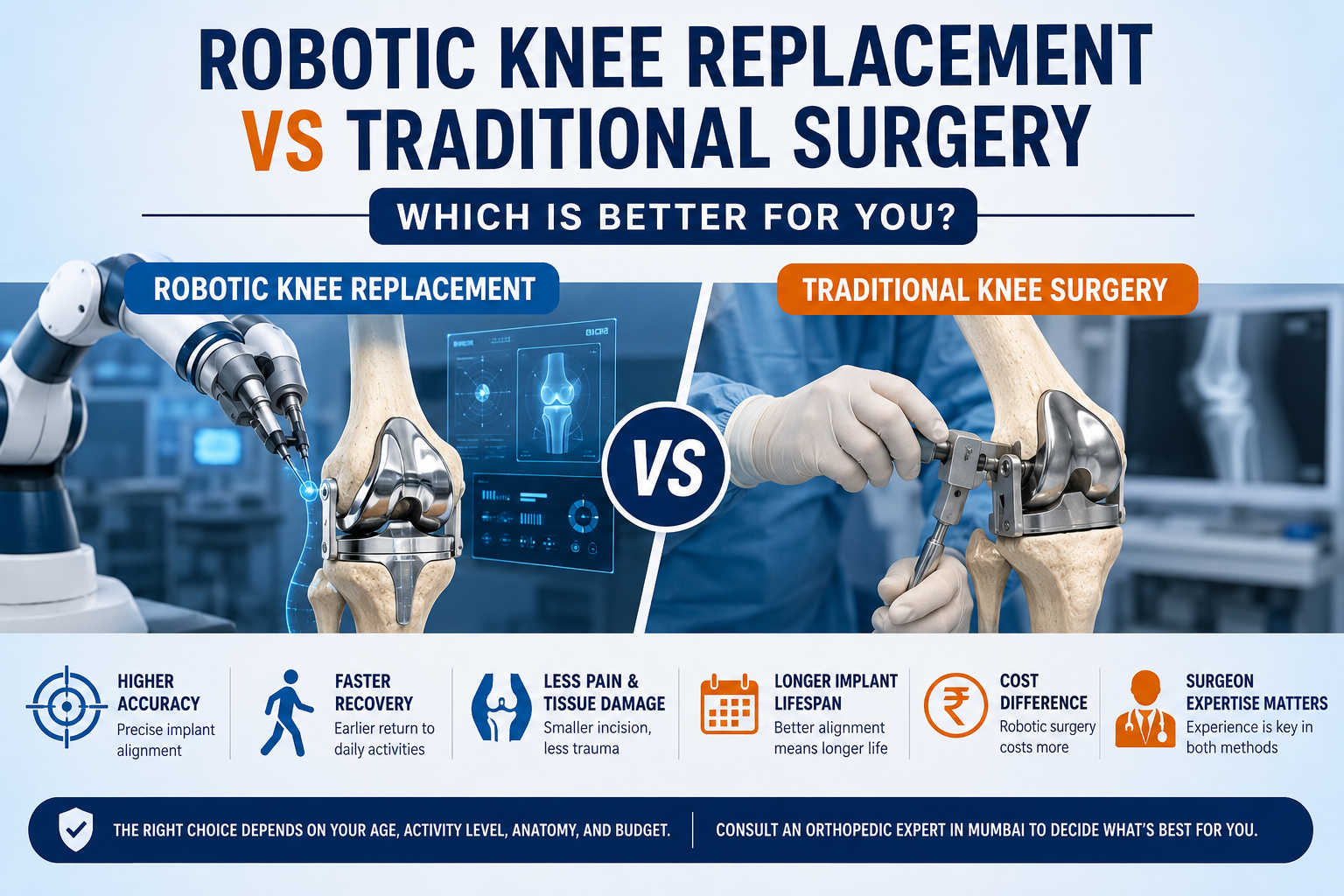
Robotic Knee Replacement vs Traditional Surgery: Which Is Better for You?
Every year, thousands of patients across Mumbai search for answers about knee replacement surgery. Some come in limping. Some have been putting off the decision for years. Almost all of them ask the same question within the first five minutes of consultation: “Doctor, should I go for robotic or traditional?”
If you are searching for robotic knee replacement vs traditional surgery, dealing with knee pain treatment in Mumbai, or trying to understand whether robotic knee replacement is actually worth the extra cost, you are in the right place. This blog covers everything: how each procedure works, who should choose what, recovery timelines, risks, costs, and what the latest research actually says. Whether you are a patient, a caregiver, or just doing your research before booking an appointment with an orthopedic doctor in Mumbai, read this fully before making any decision.
Knee arthritis does not wait. But a wrong decision lasts years. So let’s get this right.
Understanding Knee Replacement Surgery: The Basics
Before comparing robotic and traditional approaches, it helps to understand what knee replacement surgery actually involves.
Your knee joint has three main compartments: the inner (medial) side, the outer (lateral) side, and the area under the kneecap (patellofemoral). In knee arthritis treatment, the goal is to remove the damaged cartilage and bone from these surfaces and replace them with an artificial implant made of metal alloys and medical-grade plastic. This implant mimics the natural movement of a healthy knee.
Knee replacement is not a last resort anymore. With modern implants and surgical techniques, patients in their 40s and 50s are now good candidates, especially with materials that last 25 to 35 years. The conversation has shifted from “how long will I wait?” to “which type gives me the best outcome for my lifestyle?”
That is exactly what this blog answers.
What Is Traditional Knee Replacement Surgery?
Traditional knee replacement surgery has been performed since the late 1960s and has helped millions of people regain mobility worldwide. In Mumbai, many skilled orthopedic surgeons still perform this procedure routinely with strong outcomes.
Here is how it works in simple terms. The surgeon makes an incision of about 20 to 30 centimeters along the front of the knee. Damaged cartilage and bone are removed using standard surgical instruments called cutting guides. These guides help the surgeon shape the bone so the implant fits correctly. The artificial joint components are then cemented or press-fit into place.
The entire procedure typically takes 1 to 2 hours. After surgery, most patients spend 3 to 5 days in the hospital and begin physiotherapy within 24 to 48 hours.
What makes traditional surgery reliable: The technique is well-established, widely available, and performed by thousands of surgeons across India. When done by an experienced surgeon with high case volume, outcomes are genuinely good. According to available data, over 90% of patients report significant improvement in pain and function after traditional knee replacement.
Where it has limits: The alignment of the implant depends on the surgeon’s eye, experience, and the standard cutting guides used. These guides are not personalized to your anatomy. Small deviations in alignment, even a few degrees, can lead to uneven wear of the implant over years. This is not a flaw in the surgeon. It is a limitation of the method.
What Is Robotic Knee Replacement?
Robotic knee replacement in Mumbai has grown significantly over the last five years. Hospitals now use robotic platforms like MAKO (Stryker), CORI (Smith and Nephew), VELYS (DePuy Synthes), and CUVIS to assist surgeons during the procedure. These are not robots that operate independently. They are precision-guided tools that work under the surgeon’s full control.
Here is the step-by-step of how robotic knee replacement actually works:
Step 1: Pre-surgery CT Scan A CT scan of your knee is done before the operation. This gives the software a detailed picture of your bone structure, angles, and joint spacing.
Step 2: 3D Surgical Planning The robotic software creates a three-dimensional digital model of your knee. Your surgeon uses this model to plan exactly where the cuts will be made, how the implant will sit, and how the leg alignment should look after surgery. This planning happens before you even enter the operating room.
Step 3: Guided Surgery with Real-Time Feedback During surgery, the robotic arm assists the surgeon by providing real-time haptic (physical) feedback. If the surgeon’s tool moves even slightly outside the planned boundary, the robotic arm resists the movement. This keeps the cuts within sub-millimeter accuracy.
Implant alignment accuracy in robotic surgery is less than 0.5 millimeters, compared to the 2 to 4 millimeter range in traditional surgery. That difference sounds small. But in a joint that carries your entire body weight every day, it matters enormously over 10 to 20 years.
Step 4: Smaller Incision, Less Tissue Damage Because the cuts are more precise, the incision is often smaller. Less surrounding soft tissue is disturbed. This is one reason patients after robotic knee replacement in Mumbai tend to experience less post-operative pain and recover faster in the first few weeks.
Robotic Knee Replacement vs Traditional Surgery: Side-by-Side
| Factor | Traditional Knee Surgery | Robotic Knee Replacement |
| Planning method | X-ray and surgeon experience | CT scan and 3D surgical planning |
| Implant alignment accuracy | 2 to 4 mm range | Less than 0.5 mm |
| Customization | Standard cutting guides | Patient-specific anatomy mapping |
| Incision size | 20 to 30 cm | 10 to 15 cm (often smaller) |
| Surgical time | 1 to 2 hours | 1.5 to 2.5 hours |
| Hospital stay | 3 to 5 days | 2 to 3 days |
| Post-operative pain | Moderate | Generally lower |
| Recovery to daily activity | 6 to 12 weeks | 4 to 8 weeks |
| Full recovery | 3 to 6 months | 2 to 4 months |
| Blood loss | Moderate | Lower |
| Risk of revision surgery | Slightly higher over time | Lower due to alignment precision |
| Implant lifespan | 15 to 20 years | Potentially 20 to 30+ years |
| Cost in Mumbai | ₹1,50,000 to ₹3,50,000 per knee | ₹2,50,000 to ₹5,00,000 per knee |
| Surgeon dependency | High | Reduced through guided assistance |
| Availability | Widely available | Available at select centers in Mumbai |
Is Robotic Knee Replacement Actually Better? What Research Says
This is the honest part most blogs avoid.
A 2024 study from UT Southwestern Medical Center found that robotic knee replacements had better average outcomes than manual surgeries overall. However, they also noted the higher cost and said it does not automatically justify robotic surgery for every patient.
A 2023 review by Bensa et al. found no statistically significant difference in pain, mobility, or function between robotic and traditional surgery in certain patient groups. This sounds like robotic technology does not matter, but that conclusion misses the point. The difference shows up over time, in implant longevity and revision rates, not necessarily in short-term function scores.
A separate 2024 study published in Archives of Orthopaedic and Trauma Surgery analyzed large registry data and found that while robotic surgery does not eliminate early implant failures, it does improve alignment consistency. And consistent alignment is what protects the implant from uneven wear over 15 to 20 years.
The short version: robotic surgery is not magic. But it does give you a better-placed implant that has a higher chance of lasting longer without revision. That advantage becomes more valuable the younger and more active you are.
Who Should Choose Robotic Knee Replacement?
Robotic knee replacement is a particularly strong choice if you fall into one or more of these categories:
You are below 65 years old. Younger patients need implants that last longer. Precise alignment reduces wear, which is critical if you want to avoid a second surgery in your 70s.
You are physically active. If you plan to return to walking, swimming, cycling, or light sports, your knee will take more stress. A well-aligned implant handles that stress better.
Your anatomy is complex. Patients with severe deformity, previous fractures, or unusual bone geometry benefit most from 3D pre-planning because standard guides simply do not account for their anatomy.
You have had a previous knee surgery. Revision cases are more complex. Robotic guidance helps navigate existing hardware and altered anatomy with much greater precision.
You want to minimize recovery time. If you are a working professional in Mumbai who cannot afford months off work, the shorter early recovery with robotic surgery matters practically.
You are worried about getting it right the first time. Revision surgery is more difficult, more expensive, and more painful than the primary surgery. Getting the first surgery right reduces that risk.
Who Can Do Well with Traditional Knee Replacement?
Traditional knee replacement surgery is not inferior by default. It remains a well-tested, effective option for the right patient.
You are likely a good candidate for traditional surgery if:
You are above 65 with lower activity demands. If walking comfortably and climbing stairs is your goal, traditional surgery achieves this reliably. The long-term alignment advantage of robotic surgery matters less when the joint will not be stressed as heavily.
Your anatomy is straightforward. Patients with typical bone structure and minimal deformity often do well with standard cutting guides. The customization advantage of robotic surgery is smaller in these cases.
Budget is a real constraint. The cost difference between robotic and traditional surgery in India is real, typically ₹1 to 2 lakh per knee. If robotic surgery is not accessible due to cost, and your surgeon has high volume experience, traditional surgery is a solid decision.
The hospital does not offer robotic technology. Not every hospital in Mumbai has a robotic platform. A skilled surgeon performing traditional surgery in a good facility will give you better results than an inexperienced surgeon using robotic technology.
The critical point: the surgeon’s experience matters in both approaches. Always ask your doctor how many of each procedure they have performed.
Risks and Complications: What Nobody Talks About
Every surgery carries risk. Both robotic and traditional knee replacement share some common risks: infection, blood clots, implant loosening, nerve damage, and stiffness. These risks exist regardless of method.
Risks specific to traditional surgery:
- Slightly higher chance of implant misalignment over time
- Greater tissue disruption due to larger incision
- Longer early recovery due to more swelling and pain
Risks specific to robotic surgery:
- Longer surgical time (30 to 60 minutes more), which marginally increases infection and anesthesia exposure
- Technology dependence: if the robotic system has a calibration issue, surgery may need to revert to traditional method
- Not all surgeons are trained equally on every robotic platform
What patients rarely ask but should: How many robotic knee replacements has your surgeon performed on this specific platform? A surgeon who has done 20 robotic cases performs very differently from one who has done 500. The robot supports precision, but the surgeon’s judgment still guides the entire operation.
Implant Types Used in Knee Replacement Surgery
The type of implant used affects your outcome as much as the surgical method does.
Cemented implants are fixed using bone cement. They are stable immediately after surgery and suitable for most patients, especially older ones.
Cementless implants rely on bone growing into the implant surface over time. They are better suited for younger patients with good bone density because they create a stronger long-term bond.
Oxidized zirconium implants are a newer option now available at select robotic joint replacement hospitals in Mumbai. They are harder, smoother, and expected to last 30 to 35 years. They are particularly relevant for patients in their 40s and 50s who want one surgery for life.
High-flex implants allow greater bending angle in the knee, which is important for Indian patients who need to sit cross-legged, climb stairs, or squat for daily activities.
In robotic surgery, implant selection is combined with precise 3D surgical planning, which means the implant is not just chosen, it is positioned with accuracy specific to your anatomy.
Recovery: Week by Week
Robotic Knee Replacement Recovery Timeline
Week 1: You stand within 24 hours. Walking with support begins on day 2. Pain is managed with medication. Swelling is present but typically less than traditional surgery.
Week 2 to 4: Physiotherapy begins in full. You walk without a walker in most cases. Stair climbing is introduced carefully.
Week 4 to 8: Most patients return to light daily activities, office work, and short walks outside. Driving is usually possible by week 6 with left knee surgery.
Month 3 to 4: Most patients report feeling close to normal. Strength and confidence build through continued therapy.
Traditional Knee Replacement Recovery Timeline
Week 1: Similar early mobilization, though pain and swelling are typically higher. Standing and walking with support begins within 48 hours.
Week 2 to 6: Physiotherapy progresses more slowly. Swelling may persist for several weeks. Walking aids are needed longer.
Month 2 to 3: Daily activities resume for most patients. Office work is possible. Light walking improves steadily.
Month 3 to 6: Full recovery. Some patients take the full 6 months to feel comfortable with longer walks and stairs.
One thing that surprises almost every patient: recovery depends more on your pre-surgery fitness and your commitment to physiotherapy than on which surgical method was used. Patients who exercise before surgery recover faster regardless of approach.
Robotic Knee Surgery Success Rate
At leading advanced knee surgery Mumbai centers, robotic knee surgery success rates sit above 95% for patients returning to normal daily activity within 3 months. Patient satisfaction scores are consistently high, with most reporting significantly reduced pain and improved mobility.
The longer-term data is equally encouraging. Because implant alignment accuracy is better with robotic surgery, the rate of revision surgery at 10 years is measurably lower. When an implant wears evenly, it lasts longer. When it wears unevenly, problems show up around the 8 to 12 year mark and revision becomes necessary.
For a patient in their 50s, avoiding revision surgery at age 65 is a major quality-of-life outcome. That is the case for robotic surgery that the short-term studies do not fully capture.
Cost of Robotic Knee Replacement in India: Full Breakdown
The cost of robotic knee replacement in India depends on several factors. Here is a transparent breakdown for Mumbai patients.
Traditional Knee Replacement Surgery in Mumbai:
- Surgery and hospital stay: ₹1,50,000 to ₹2,50,000
- Implant cost: ₹50,000 to ₹1,00,000
- Total per knee: ₹1,50,000 to ₹3,50,000
Robotic Knee Replacement in Mumbai:
- Surgery and hospital stay: ₹1,80,000 to ₹3,00,000
- Robotic platform usage fee: ₹30,000 to ₹50,000
- Implant cost (including premium options): ₹80,000 to ₹2,00,000
- Total per knee: ₹2,50,000 to ₹5,00,000
Bilateral (Both Knees) Robotic Surgery in Mumbai: ₹4,50,000 to ₹9,00,000
Insurance: Several major insurers in India now cover robotic knee replacement, but coverage varies. Cashless insurance is available at empaneled hospitals. Always get pre-authorization before scheduling surgery.
Medical loans and EMI: Many hospitals offer no-cost EMI options for patients who need financial flexibility. Ask about this during your consultation.
Frequently Asked Questions
Is robotic knee replacement painful?
Post-operative pain exists with both methods. With robotic surgery, patients generally report less pain in the first two weeks because of the smaller incision and lower tissue disruption. Pain management protocols are similar for both.
How long does robotic knee replacement last?
With precise alignment, robotic implants are expected to last 20 to 30 years or more, especially with newer materials like oxidized zirconium. Traditional implants last 15 to 20 years on average.
Can I sit cross-legged after knee replacement?
This depends on the implant type, not just the surgical method. High-flex implants allow greater bending angles. Discuss this with your surgeon at Dr Joints specifically, since cross-legged sitting and squatting are daily needs for many Indian patients.
Is robotic surgery safe for elderly patients?
Yes, age alone is not a barrier. However, for older patients with simpler anatomy and lower activity demands, traditional surgery often provides equivalent results at lower cost. Your doctor will assess your specific case.
What is the best robotic knee replacement center in Mumbai?
Look for centers with high case volume on the robotic platform they use, surgeons who are specifically trained on that system, and hospitals with a structured rehabilitation program. Volume matters more than just having the machine.
How soon can I travel after knee replacement?
Short car travel is usually safe after 2 to 3 weeks. Long-distance flights should wait until around 6 weeks, when blood clot risk reduces and mobility improves.
Why Dr Joints for Knee Replacement Surgery in Mumbai?
At Dr Joints, we perform both robotic and traditional knee replacement and recommend based on your anatomy, age, activity level, and budget, not on what generates higher revenue.
We use the latest robotic platforms with 3D surgical planning for all robotic cases. Our orthopedic doctors in Mumbai have high case volume on both procedures. We offer structured physiotherapy beginning within 24 hours of surgery, and our consultations are honest: if traditional surgery is the right choice for you, we will tell you that directly.
Whether you are looking for advanced knee surgery in Mumbai, seeking a second opinion, or trying to understand your treatment options for knee arthritis, schedule a consultation with our team. We will review your scans, answer every question, and give you a treatment plan that fits your life.
Final Word: Which Surgery Should You Choose?
For most patients who are active, below 65, and want their implant to last as long as possible: robotic knee replacement is the better investment. The precision, faster early recovery, and longer implant life justify the additional cost.
For patients who are older, have simpler anatomy, and are working within a tighter budget: traditional knee replacement surgery performed by an experienced surgeon remains a genuinely good option.
The worst decision is to delay. Knee arthritis progresses. The longer you wait, the more bone loss occurs, the weaker your muscles get, and the harder recovery becomes. Both surgeries are better done at the right time than too late.
Book a consultation at Dr Joints. Bring your X-rays or MRI scans. Ask every question on this list. You deserve a clear answer before you decide.