
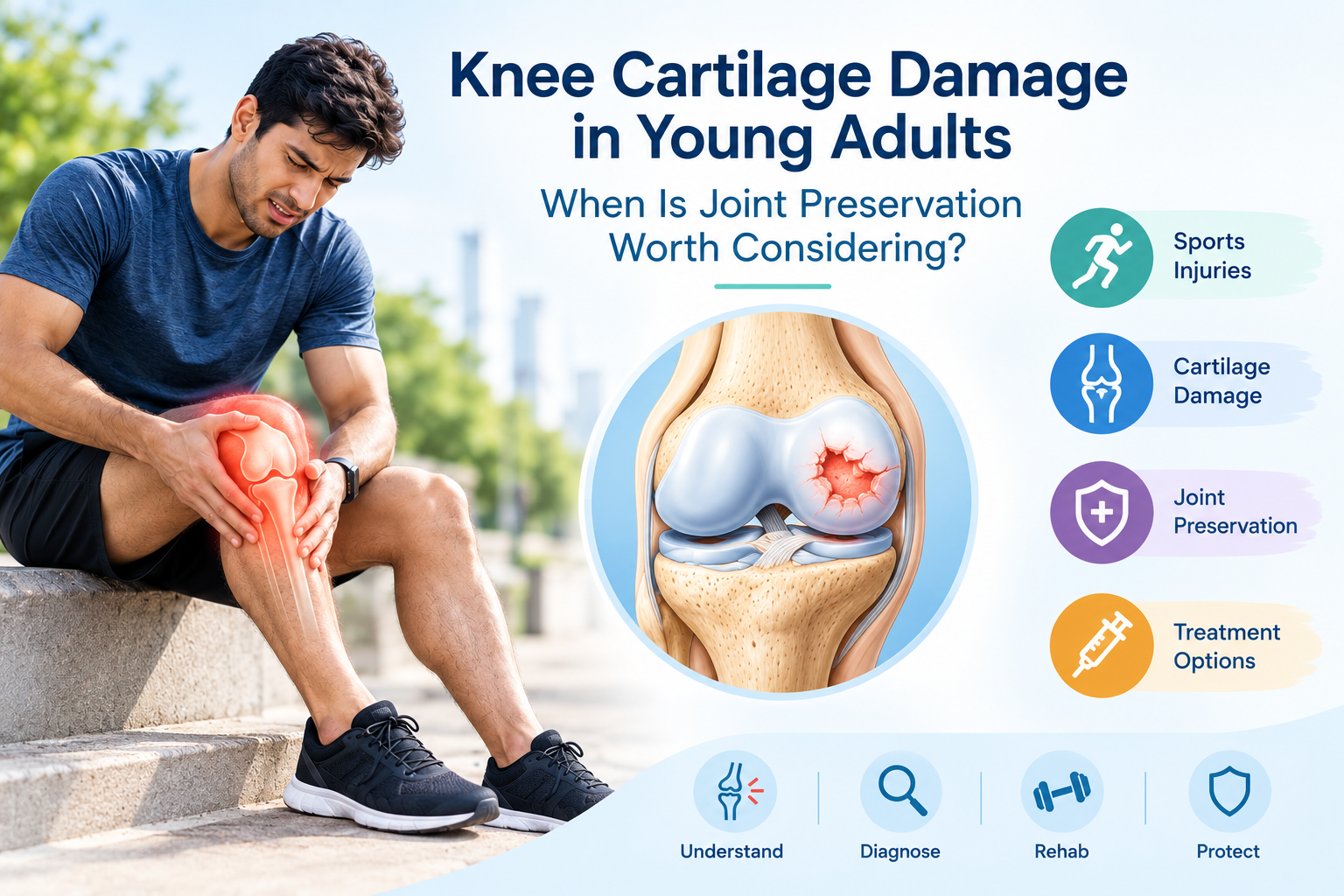
Knee Cartilage Damage in Young Adults: When Is Joint Preservation Worth Considering?
Persistent knee pain is something most people expect in their 60s or 70s, not in their 20s or 30s. Yet more and more young adults walk into clinics with a knee that aches after a run, swells after a game, or catches when they climb stairs. In many of these cases, knee cartilage damage is the hidden reason behind the trouble.
Knee pain in young adults is often brushed off as a “sports strain” or “weak muscles,” and people keep pushing through it. The problem is that cartilage does not heal as easily as skin or muscle. Ignoring it can slowly turn a small, fixable problem into a long-term one. Knee problems in young adults deserve proper attention, because the knee you protect today is the knee you will depend on for decades.
This is where joint preservation comes in. Instead of waiting until a joint wears out, joint preservation focuses on repairing or protecting your natural knee for as long as possible. But it is not right for everyone, so let’s understand when it makes sense.
Understanding Knee Cartilage Damage
Think of cartilage as the smooth, slippery cushion that covers the ends of your thigh bone, shin bone and kneecap. This articular cartilage lets your bones glide over each other without friction and absorbs the shock of every step, jump and landing.
Cartilage damage can look different from person to person. Some people have a focal cartilage defect, which is a small, well-defined patch where the cartilage has worn away or come loose. Others have a knee cartilage tear involving the meniscus, the C-shaped shock absorber that sits between the thigh bone and shin bone. Both can cause pain, but they behave differently and are treated differently.
A general knee injury, such as a mild sprain or muscle strain, usually settles with rest and time. Cartilage damage is different because cartilage has very little blood supply. That is why it heals poorly on its own, and why symptoms can linger for months or even years.
Common Knee Pain Causes in Young Adults
There is rarely one single reason behind knee pain. The most common knee pain causes in young adults include:
Sports injuries and sudden twisting movements, especially in football, cricket, badminton and basketball
Repetitive loading from running, gym training or jumping sports
Earlier ligament injuries, such as an ACL tear, that left the knee a little unstable
Poor alignment of the legs, such as bow legs or knock knees, which overloads one side of the joint
Overuse without enough recovery time
A single knee injury can be enough to damage cartilage, particularly when the knee twists under body weight. In other cases, years of repeated stress slowly wear the surface down. Either way, the result is often ongoing knee joint pain that does not go away with the usual home remedies.
Signs and Symptoms to Watch For
Cartilage damage can be sneaky. Early on, you may only notice a dull ache after exercise. Over time, these signs tend to show up:
Pain during or after activity, such as running, squatting or taking stairs
Swelling that comes and goes
Stiffness, especially after sitting for a long time
A catching, clicking or locking feeling inside the knee
Reduced range of motion
Difficulty putting full weight on the leg
If these symptoms last more than a few weeks, or keep returning every time you get back to your routine, it is time to get the knee examined rather than waiting it out. Persistent knee pain should never be ignored just because you are young.
How Is Knee Cartilage Damage Diagnosed?
Diagnosis starts with a conversation. Your doctor will ask how the pain began, what makes it worse, and whether you have had earlier injuries. A physical examination follows, checking swelling, tenderness, stability, movement and the way you walk.
X-rays are usually the first test. They cannot show cartilage directly, but they reveal joint space, bone alignment and early signs of arthritis. An MRI is often advised when cartilage or meniscus damage is suspected, because it shows the soft tissues in much better detail.
Together, these tests help the specialist understand the size and location of the cartilage defect, the health of the meniscus, the alignment of the leg, and whether early knee arthritis has already started. This full picture matters, because the right treatment depends on it.
Knee Pain Treatment: Nonsurgical Options
Not every cartilage problem needs an operation. For many people, the first step in knee pain treatment is a structured, non-surgical plan. This can include:
Activity modification, meaning temporarily cutting back on high-impact movements that aggravate the knee
Physiotherapy to improve movement and knee control
Strengthening of the thigh, hip and calf muscles so that they share the load
Weight management, where appropriate, to reduce stress on the joint
Pain-relief medicines, taken only under medical guidance
Good cartilage damage treatment always depends on the cause and severity of the problem. A small, stable defect may settle well with rehab, while a larger or unstable one may not. These steps can also bring real knee pain relief, and they form the base of almost every knee injury treatment plan, even when surgery is eventually needed.
Knee Cartilage Repair and Joint Preservation
Joint preservation simply means trying to save and restore your own knee instead of replacing it. In selected young adults, this can help protect the joint for many more years.
Several options exist for knee cartilage repair, and your surgeon will choose among them based on the situation:
Marrow stimulation: tiny holes are made in the bone beneath the defect so that the body forms a repair tissue
Osteochondral grafting: healthy cartilage and bone from another area are used to fill the damaged spot
Cell-based procedures: your own cartilage cells are grown and implanted, where clinically indicated
The choice of cartilage repair surgery depends on defect size, location, the condition of the underlying bone, leg alignment, activity level and overall joint health.
It is also important to be realistic about knee cartilage regeneration. Biological treatments are exciting, but regeneration is not guaranteed, and the repair tissue is not always identical to the original cartilage. Each procedure has its own indications and its own outcomes, so honest expectations matter.
When Is Joint Preservation Worth Considering?
Age alone does not decide who is suitable. A 25-year-old with widespread damage may not be a candidate, while a 40-year-old with a single localized defect may do very well.
A specialist usually looks at a few key things:
Whether the defect is localized rather than spread across the whole joint
Whether symptoms are persistent despite proper conservative treatment
Whether the joint space is still preserved
Your functional goals, such as returning to sport or an active job
The condition of surrounding structures, including ligaments, meniscus and alignment
If the damage is small and you are improving, more physiotherapy and monitoring may be the best choice. If symptoms continue and the defect fits the criteria, surgery may be worth discussing.
Like any treatment, joint preservation has benefits and limits. The upside is protecting your natural joint and staying active. The trade-offs include a longer rehabilitation period, the need for patience, and the usual surgical risks. A balanced conversation with your surgeon is the best way to decide.
Knee Arthritis and Knee Osteoarthritis in Young Adults
Many people believe arthritis only affects the elderly. In reality, an old injury can trigger post-traumatic knee arthritis years later, especially when cartilage damage or ligament injuries were left untreated.
Knee osteoarthritis is different from an isolated cartilage defect. An isolated defect is a single, localized spot, with the rest of the joint still healthy. Osteoarthritis is a more diffuse process in which cartilage thins across larger areas, the joint space narrows and bone changes appear.
This difference matters. A localized injury may respond well to cartilage restoration, but widespread, advanced arthritis usually needs a different treatment approach, because repairing one spot cannot fix a joint that is worn out everywhere.
Knee Replacement Alternatives: Can Replacement Be Delayed?
For young adults, the idea of knee replacement surgery can feel frightening, and understandably so. Implants have a limited lifespan, and a younger person may outlive their first one. That is why doctors often explore knee replacement alternatives first, such as physiotherapy, injections, realignment procedures and cartilage restoration.
However, it is important to be honest: not every patient is a suitable candidate for cartilage restoration. If arthritis is already advanced, joint preservation may not give lasting relief. And delaying replacement is not always possible or helpful. Postponing an operation that is truly needed can sometimes mean more pain and weaker muscles.
The right decision is always individual. It depends on your scans, your symptoms, your lifestyle and your goals, not just your age.
What to Expect From Knee Surgery and Recovery
If knee surgery becomes necessary, recovery depends on the procedure and on the person. A minor arthroscopic procedure may allow a quicker return to normal life, while cartilage restoration usually needs a longer, more careful rehabilitation.
In general, you can expect a phase of protected movement, followed by gradual strengthening and a slow, step-by-step return to activity. Following your physiotherapy plan is just as important as the surgery itself. Rushing back to sport too early is one of the most common reasons for poor results.
Set realistic expectations, stay patient and keep in touch with your surgeon throughout recovery.
When Should You Consult a Knee Specialist?
Do not wait too long if your knee keeps bothering you. See a specialist if you have pain that lasts for weeks, repeated swelling, locking or catching, a feeling that the knee gives way, or pain that stops you from doing everyday activities or sport.
Early diagnosis makes treatment simpler and gives you more options, including joint preservation. A specialist can build a plan around your knee, your goals and your lifestyle.
Seek urgent medical help if you have a severely injured knee, cannot put weight on the leg, notice significant swelling or an obvious deformity, or have a hot, red knee along with fever.
Frequently Asked Questions (FAQs)
1. Can knee cartilage damage heal on its own?
Cartilage has a very limited ability to heal because it has little blood supply. Minor damage may settle with rest, physiotherapy and activity changes, but larger defects often do not heal fully by themselves. A proper evaluation will tell you which category your knee falls into.
2. What are the common signs of knee cartilage damage in young adults?
Common signs include pain during or after activity, swelling, stiffness, a catching or locking sensation, reduced movement and difficulty putting weight on the knee. If these symptoms continue for more than a few weeks, get the knee checked.
3. Is joint preservation better than knee replacement for young adults?
It can be, but only in selected cases. Joint preservation suits people with localized cartilage defects and a healthy remaining joint. For advanced arthritis, replacement may be the more reliable option. It depends on the individual knee.
4. Does an MRI always show cartilage damage?
An MRI is very useful for seeing cartilage and meniscus injuries, but it is read together with your symptoms and examination. Sometimes small or early defects are harder to detect, so the doctor looks at the whole picture.
5. How long does recovery take after cartilage repair surgery?
It varies with the procedure, the size of the defect and how closely you follow rehabilitation. Some procedures allow a quicker return to normal activity, while others need several months of gradual rehab. Your surgeon can give you a realistic timeline.
6. Can I still play sports after cartilage treatment?
Many people return to an active lifestyle, but the level of sport depends on the procedure and how the knee responds. Your surgeon and physiotherapist will guide you on when and how to return safely.
Final Thoughts
Knee cartilage damage in young adults is more common than most people think, and it should not be ignored. The good news is that there are many ways to manage it today, from simple non-surgical care to carefully chosen joint preservation procedures. The key is getting the right diagnosis early and choosing a treatment that fits your knee, not just your age.
If your knee pain is not settling, speak to a knee specialist. A timely assessment could help you protect your natural joint and keep you moving for years to come.