
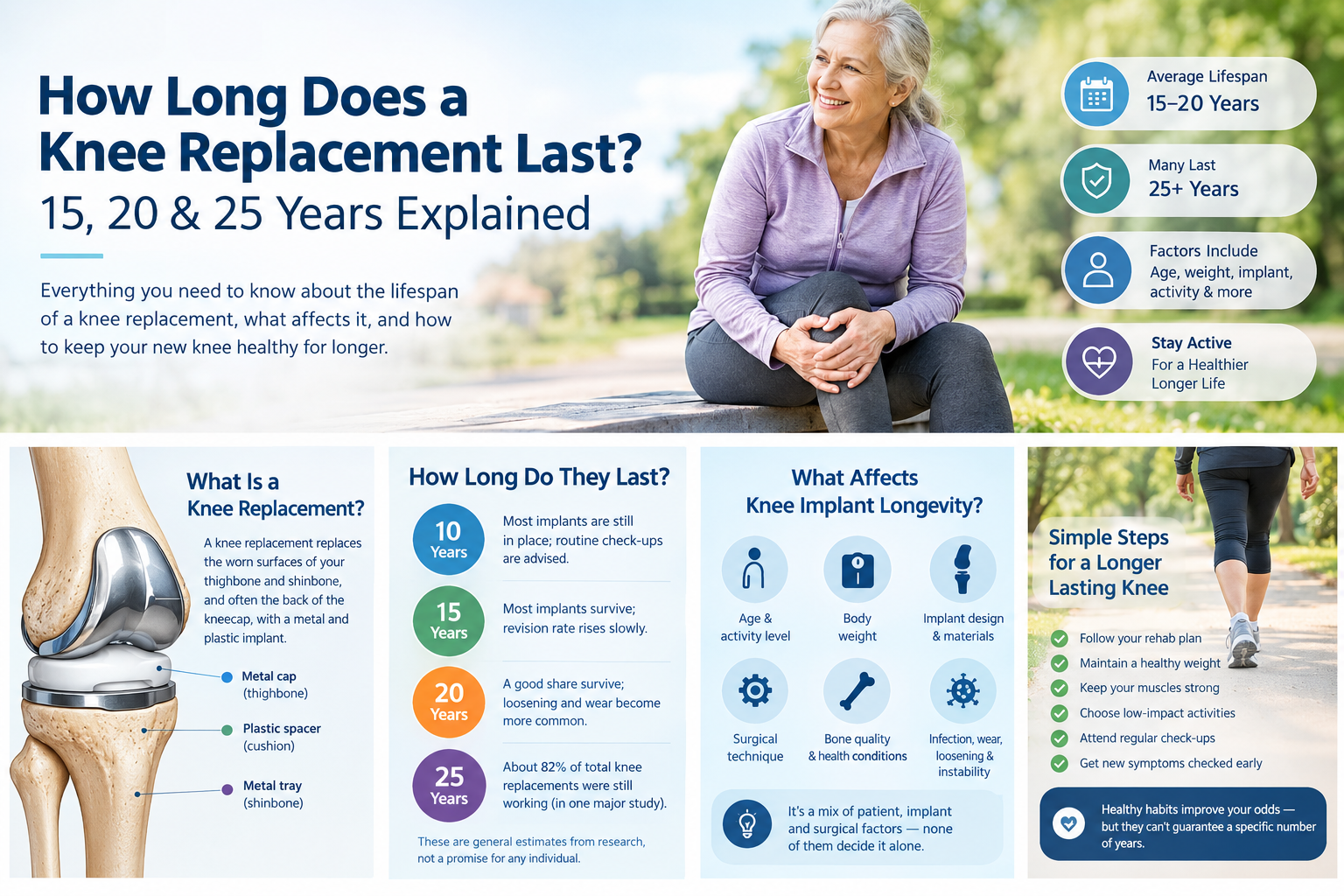
How Long Does a Knee Replacement Last? 15, 20 & 25 Years Explained
Sit with a few knee replacement patients in a clinic and you will notice the same question coming up sooner or later. How long does a knee replacement last? Some ask it before surgery, when they are weighing the decision. Others ask it ten years later, every time the knee twinges on a cold morning.
The short version is encouraging. Most modern knee replacements work well for fifteen to twenty years, and a good number go beyond that. The longer version is a bit more nuanced, because the answer depends on you, your implant and how the surgery went. This article covers what the research says, what shapes the result, which signs deserve attention and what happens if a second operation is ever needed.
How Long Does a Knee Replacement Last on Average?
Large studies and national joint registries point in the same direction. Most implants are still going strong ten to fifteen years after surgery. Surgeons often tell patients something like this: a well-done operation should give you one to two decades of comfortable walking, and plenty of people get more.
There is a small catch in how people read these numbers. “Survival” in research only means the implant has not been removed or revised. It says nothing about how the knee feels day to day. A person can have a knee that is wearing slightly on X-ray yet walks without pain for years, and another can have an intact implant but still be unhappy with stiffness. Pain relief, function and implant survival are three different things, and good reports keep them apart.
You will also see different percentages in different papers. That is normal. The implant design, the patient group, the reason for surgery and how long people were followed all change the figures. So think of knee replacement lifespan as a range and not a fixed number, and think of any statistic as an estimate for a group of people, not a promise for one person.
When patients ask how long do knee replacements last, we usually answer with the range first and then talk about their own situation. That second part matters more than the first.
Can a Knee Replacement Last 15, 20, or 25 Years?
Yes, it can, and in many patients it does. What you should not hear is that it always will. Here is how things look at each stage.
Knee Replacement After 10 Years
By year ten, most people have forgotten the surgery ever happened. Stairs, shopping trips and sitting cross-legged on a chair feel routine. Registry data from large countries show that the vast majority of implants are still in place at this point.
Even so, knee replacement after 10 years is a sensible time for a check-up and an X-ray, even if you feel perfectly fine. Early wear or tiny changes around the implant can be spotted long before they cause trouble. And if some pain does appear, do not assume the worst. The cause might be a tight muscle, a stiff joint or even a problem in the back or hip.
Knee Replacement After 15 Years
Fifteen years in, most implants are still doing their job. The share that needs revision creeps up slowly with time, which is expected with any mechanical joint that has been used for years. This is the stage where body weight, activity level and the original implant design begin to show their influence.
If you are living with a knee replacement after 15 years and walking comfortably, there is usually nothing to worry about. A yearly or two-yearly review is simply a good habit.
Knee Replacement After 20 Years
Fewer patients have been followed this long, so the evidence is thinner, though still positive. Long-term case series suggest that a good proportion of implants last twenty years. Some do need attention by then, and the usual reasons are loosening, wear of the plastic insert, an infection or an injury along the way.
One more thing worth knowing: the implants in these studies were put in one or two decades ago. Materials and techniques have moved on since, so results for today’s patients may differ. That is not a promise of better outcomes, only a reminder that older data describes older designs.
Knee Replacement After 25 Years
The best-known analysis here is a large systematic review and meta-analysis by Evans and colleagues, published in The Lancet in 2019. It pooled long-term case series and national registry reports and estimated that about 82 percent of total knee replacements in people with osteoarthritis were still working at 25 years. For partial knee replacements the estimate was lower, at roughly 70 percent.
Read that number carefully. It means most implants reached 25 years, but about one in five did not. So knee replacement after 25 years is a real possibility, and it is not a guarantee. The authors also pointed out that data quality differs between studies.
Quick Comparison: 10, 15, 20 and 25 Years
Milestone | What studies and registries generally show | How strong is the evidence |
10 years | Large majority of implants still in place; routine follow-up advised | Strong (large registries) |
15 years | Most implants survive; revision rate rises slowly | Good (registries and long-term series) |
20 years | A good share survive; loosening and wear are more common reasons for revision | Moderate (fewer patients, older designs) |
25 years | About 82% of total knee replacements survived in osteoarthritis patients in one major pooled analysis | Limited but useful |
These are general estimates from published research, not predictions for any individual patient.
What Is the Lifespan of a Total Knee Replacement?
In a total knee replacement, the worn surfaces of the thighbone and shinbone, and often the back of the kneecap, are removed and replaced. A typical knee replacement implant has three main parts: a metal cap on the thighbone, a metal tray on the shinbone, and a medical-grade plastic spacer in between that works like a fresh cushion.
So how long does total knee replacement last? Going by the figures above, most last somewhere between 15 and 25 years, though the total knee replacement lifespan for any single person depends on the factors below. A partial knee replacement, where only one section of the joint is replaced, often gives a quicker early recovery, but long-term studies show somewhat higher revision rates than total replacement.
What Affects the Life of a Knee Implant?
People like to hunt for one main reason why an implant lasts or does not. Honestly, there isn’t one. It is a mix, and some parts are beyond anyone’s control.
Age and activity come first. A younger, very active person asks more of the knee over a longer lifetime, so the chance of needing revision at some point is higher. That is not a reason to avoid surgery when it is truly needed, only a reason to plan carefully.
Body weight matters because every step sends several times your weight through the joint. Over years, that extra load can speed up wear and loosening.
Then there is the implant itself. Design and materials play a big part in knee implant durability, and your surgeon can tell you what is known about the type being used. Alignment and technique count too, since an implant that sits well and is balanced with the ligaments tends to wear evenly. Your own anatomy plays a role as well. We want to be upfront about robotic and computer-assisted tools here: they can help with precision, but no research shows they guarantee an implant that lasts longer.
Bone quality, diabetes, inflammatory arthritis and similar conditions also influence how well the implant holds and how you heal. And finally, there are the problems that most often shorten an implant’s life: infection, instability, loosening and wear.
In short, knee implant lifespan comes from a mix of patient, implant and surgical factors, and none of them decides it alone.
How to Improve Knee Replacement Longevity
You cannot control everything, but you can look after the knee you have been given. Most of it is common sense.
Follow the rehab plan your physiotherapist gives you, especially in the first three months. If you are carrying extra weight, bringing it down helps, because less load means less wear. Keep your thigh muscles strong with the exercises your team recommends, since strong muscles share the work with the joint.
Pick low-impact activities. Walking, cycling and swimming are usually fine, while high-impact sports and heavy twisting are often discouraged, so check with your surgeon. Keep your follow-up appointments even when all feels well. And if the knee starts to ache, swell, stiffen or feel unsteady, get it looked at early and do not wait it out.
One honest caution: good habits improve your odds for knee replacement longevity, but they cannot guarantee a specific number of years.
What Are the Signs of a Knee Replacement Problem?
Pain that keeps getting worse or does not settle, swelling that keeps coming back, a knee that feels wobbly, less bending than before, or trouble putting weight on the leg are all worth mentioning to your surgeon.
These symptoms can point to knee replacement complications such as infection, loosening of the implant, wear of the plastic insert, instability, a fracture around the implant or stiffness from scar tissue. But please do not panic. Pain does not mean the implant has failed. Many causes can be treated without another operation, and only an orthopedic assessment, usually with X-rays and sometimes other tests, can sort it out.
Some situations are urgent. Fever along with a hot, red, swollen knee, fluid leaking from the wound, or sudden severe pain with inability to stand on the leg needs medical attention the same day.
When Is Knee Replacement Revision Necessary?
Knee replacement revision simply means a second operation to repair, adjust or replace one or more parts of an earlier implant. Doctors consider revision knee replacement surgery when there is a clear reason, such as a loose implant, infection, heavy wear, instability or a fracture, and when simpler treatment will not fix it.
It is usually a bigger operation than the first. The surgeon may need to remove the old components, deal with bone loss and use special implants that give extra support. That is why the plan is built around what exactly went wrong and around the patient’s overall health. And not everyone with pain needs revision. Many are managed with medicines, physiotherapy or smaller procedures.
Does Knee Replacement Cost Go Up If Revision Is Needed?
Often it can. Knee replacement cost depends on the type of implant, hospital and room charges, surgeon and anaesthesia fees, how complex the surgery is and how much rehabilitation follows. Revision usually needs more complex implants and a longer operation, so the final bill can be higher than for the first surgery.
Costs also differ a lot from one hospital and city to another, and insurance cover depends on your policy. The best step is to ask for a written estimate that clearly lists what is included before you decide anything.
How Recovery Affects Long-Term Results
Knee replacement recovery begins almost straight away. Most patients are helped to stand and walk within a day or so, and then follow a physiotherapy plan that slowly builds movement and strength. Knee replacement surgery recovery keeps improving for several months, and many people notice small gains for up to a year.
It helps to separate two ideas here. Recovery after the operation is about getting back to normal life. Long-term care is about protecting the implant over the years. A quick recovery is wonderful, but it does not mean the implant will last longer, and a slow one does not mean it will fail sooner. Both deserve attention, and your surgeon can guide you on each.
When Should You See an Orthopedic Surgeon?
Think about an assessment if knee pain limits your walking, if the knee has not recovered as expected, if any of the warning signs above sound familiar, or if you simply feel uneasy about a replacement you had years ago. Early advice usually keeps the options simpler.
At Dr. Joints in Mumbai, Dr. Safiuddin Nadwi and the team see patients with knee problems, from those thinking about a first replacement to those with concerns about an older one. A consultation helps you understand your own X-rays, your choices and a realistic outlook, without pressure and without promises of guaranteed results.
Frequently Asked Questions About Knee Replacement Lifespan
- How long does a knee replacement last on average?
Most last 15 to 20 years, and many go longer. Averages hide big differences between people, because age, weight, activity, implant and surgical factors all play a part. Your surgeon can give a more personal estimate once they have seen your X-rays and examined the knee. - How long do knee replacements last in younger patients?
Younger patients are usually more active and live longer with the implant, so they have a higher chance of needing revision at some stage. Many still do very well for years. Sensible activity choices and regular follow-up go a long way in protecting the knee. - Can a knee replacement last 25 years?
Yes. One large pooled analysis estimated that about 82 percent of total knee replacements in osteoarthritis patients were still working at 25 years. That means most, not all. It is a real possibility, but it should not be treated as a promise for every person. - How long do knee implants last?
Knee implants commonly last between 15 and 25 years, depending on design, materials, alignment and how the knee is used. Newer designs have less long-term data, since studies need many years to follow patients. Your surgeon can explain what is known about the specific implant being used. - What happens to a knee replacement after 10 years?
For most people, nothing dramatic. The knee keeps working and life carries on as usual. A check-up with an X-ray is still wise at this stage, to look for early wear or loosening, even when there are no symptoms at all. - Is a knee replacement after 20 years likely to need revision?
Not necessarily. Studies suggest a good share of implants are still working at 20 years, though the chance of revision does rise with time. Whether yours needs it depends on symptoms, X-ray findings and your overall health, so a proper assessment beats guessing. - What are the signs that a knee replacement is wearing out?
Watch for pain that returns or worsens, swelling, a feeling of looseness or giving way, reduced movement and trouble bearing weight. These signs have several possible causes, so they call for a medical check and not panic. Fever with a hot, swollen knee needs urgent attention. - Can a knee replacement implant be replaced?
Yes. A worn, loose or infected implant can be replaced fully or partly in a second operation. The surgery is usually more complex than the first and uses specialised components, so the surgeon plans it carefully around the cause of the problem. - What factors affect knee implant durability?
Age, activity level, body weight, implant design, alignment, surgical technique, bone quality, other health conditions, infection risk and how well rehabilitation is followed all matter. No single factor decides the outcome, which is why durability is hard to predict for any one person. - Does revision knee replacement surgery take longer to recover from?
Often it does. The operation is usually longer and more complex, so recovery can be slower and rehabilitation more demanding than after the first replacement. The timeline depends on how much work was needed, and your surgeon and physiotherapist will set realistic goals with you.
Conclusion: Understanding Your Knee Replacement’s Long-Term Outlook
So, how long does a knee replacement last? For most people, a good fifteen to twenty years, and for many, twenty-five or more. Research suggests that about four out of five total knee replacements were still working at 25 years, but that is an average and not a guarantee. How you use your knee, your general health, the implant and the surgery itself all shape your own result.
What helps most is simple: keep up your exercises, watch your weight, go for regular check-ups and get new symptoms looked at early. If you have knee pain or questions about a previous operation, you are welcome to book an individual evaluation with Dr. Joints in Mumbai.