
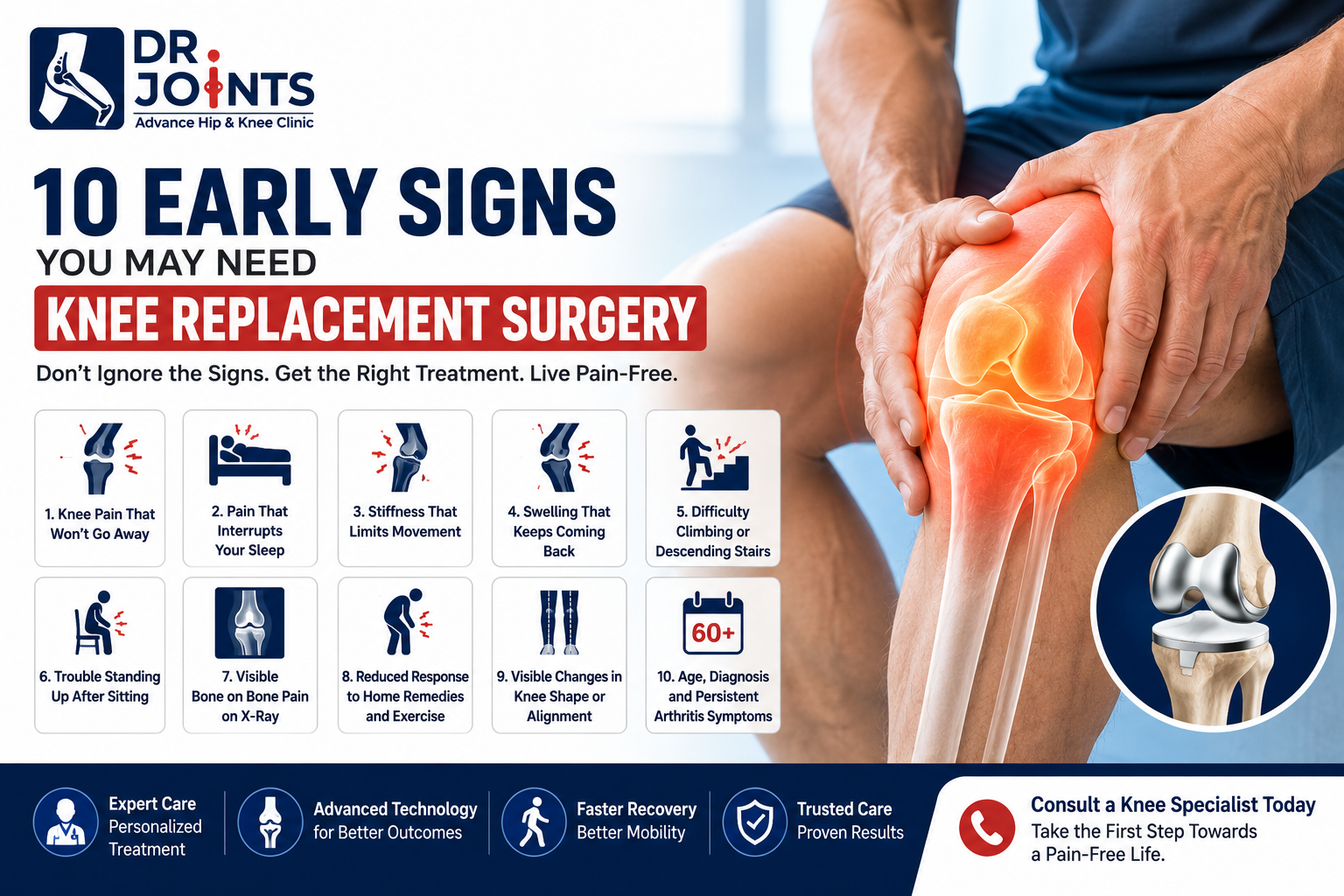
10 Early Signs You May Need Knee Replacement Surgery
If you have been dealing with knee pain for months, or even years, you are not alone. Most people do not wake up one day and decide they need surgery. It happens slowly. A little stiffness in the morning turns into knee pain climbing stairs, then swelling after a long day at work, and before you know it, you are avoiding walks with your family just to protect your knee. The tricky part is knowing when this is normal wear and tear that responds to rest and medication, and when it has quietly crossed the line into something that needs a surgeon’s opinion.
This is where most patients get stuck. They try knee pain relief options like painkillers, hot and cold compresses, and rest, and these work for a while. But if the pain keeps coming back stronger, it usually means the underlying knee pain causes have progressed beyond what conservative care can fix. Chronic knee pain that does not respond to standard knee pain treatment is often the first real clue that something bigger is going on, whether that is worsening knee arthritis symptoms, early severe knee arthritis symptoms, or cartilage that has simply worn down too far to repair on its own.
Knowing the signs you need knee replacement early can save you years of unnecessary suffering and help you make an informed decision about knee replacement surgery before the damage gets worse. A lot of patients also ask when is knee replacement necessary, and the honest answer is that it is rarely one single symptom. It is usually a pattern, a combination of knee stiffness causes, knee swelling causes, and limited movement that keeps showing up no matter what you try. This is also one of the most searched questions among people looking for a knee specialist in Dadar, an orthopedic doctor in Mumbai, or the best knee replacement surgeon in Mumbai, because knee pain rarely comes with a clear instruction manual. Below are ten signs worth paying attention to, explained in plain language, not medical jargon, along with what each one actually means for your knee.
Quick self-check before you read on. You do not need a medical degree to notice the pattern. Ask yourself if you are dealing with any of these on a regular basis: pain that lingers for weeks, stiffness every morning, swelling that keeps returning, trouble with stairs, or pain that wakes you up at night. If two or three of these sound familiar, keep reading, because the list below breaks each one down in detail.
What’s Actually Behind Your Knee Pain?
Before jumping to the signs, it helps to understand the common knee pain causes doctors see in clinics across Mumbai, from Tardeo to Dadar to Bandra. Osteoarthritis is the most frequent one. It happens when the cartilage cushioning your knee joint wears down over years of use, and it usually shows up gradually rather than all at once. Rheumatoid arthritis, an autoimmune condition, is another cause, and it tends to affect both knees together with more swelling than typical wear and tear. Old sports injuries, ligament tears, or fractures from years ago can also resurface as joint pain later in life, even if you barely think about that injury anymore. Add in factors like being overweight, a sedentary lifestyle, or a family history of arthritis, and the cartilage in your knee simply has more pressure to deal with over time. None of these causes are unusual. What matters is catching the pattern early, before the joint damage becomes severe enough that surgery is the only real option left.
1. Knee Pain That Refuses to Go Away
Occasional soreness after a long walk is normal. But knee pain not going away even after rest, ice, or a few days off your feet is a different story. When chronic knee pain sticks around for weeks or months regardless of what you do, it usually points to cartilage that has worn down significantly. This is your body’s way of telling you that something structural has changed, not just a temporary strain.
2. Pain That Interrupts Your Sleep
If you find yourself waking up at night because your knee is throbbing, or you cannot find a comfortable position to sleep in, this is a red flag doctors take seriously. Pain at rest, especially at night, often means the joint damage has reached a stage where knee pain treatment through medication alone is no longer enough.
3. Stiffness That Limits Movement
Struggling to bend your knee fully, or feeling like it locks up after sitting for a while, are common knee stiffness causes linked to advanced arthritis. If you need a few minutes every morning just to get your knee moving properly, or if stiffness stops you from sitting cross-legged or kneeling, it is a sign the joint space has narrowed considerably.
4. Swelling That Keeps Coming Back
A knee that puffs up after minor activity, or stays swollen for days without an obvious injury, deserves attention. There are several knee swelling causes, ranging from mild inflammation to serious cartilage loss, but when swelling becomes a regular pattern rather than a one-off event, it usually signals ongoing joint damage that will not resolve on its own.
5. Difficulty Climbing or Descending Stairs
This is one of the most common complaints doctors hear. Knee pain climbing stairs, especially going down, happens because the kneecap and surrounding cartilage bear extra pressure with every step. If you have started avoiding stairs, taking them one at a time, or leaning heavily on the railing, your knee is telling you it cannot handle the load it used to.
6. Trouble Standing Up After Sitting
Knee pain getting up from a chair, a car seat, or the floor is another early warning sign. Many patients describe it as their knee feeling “stuck” for the first few steps after standing. This happens because stiff, damaged joints need a moment to loosen up, and it tends to get worse the longer the underlying condition is left untreated.
7. Visible Bone on Bone Pain on X-Ray
If your doctor has already mentioned bone on bone knee pain after reviewing an X-ray, this means the cartilage that once cushioned your joint has worn away almost completely. At this stage, home remedies and physiotherapy provide only temporary comfort. This finding is usually one of the clearest indicators that surgery may be the most effective long-term solution.
8. Reduced Response to Home Remedies and Exercise
Early on, knee pain home remedies like warm compresses, turmeric, weight management, and rest can genuinely help. Likewise, knee pain exercise routines built around strengthening the quadriceps and hamstrings often ease mild discomfort. But when these methods stop making a real difference, and you find yourself relying on painkillers just to get through the day, it is a sign the joint has moved past what conservative management can fix.
9. Visible Changes in Knee Shape or Alignment
Some patients notice their knees gradually turning inward or bowing outward over time. This deformity happens when uneven cartilage loss changes how the leg aligns, and it tends to worsen without treatment. Beyond the physical appearance, this misalignment adds extra stress to the joint and accelerates further damage.
10. Age, Diagnosis, and Persistent Arthritis Symptoms
While there is no fixed knee replacement age, most surgeons see a rise in candidates once patients cross their late fifties, especially if they have been diagnosed with severe knee arthritis symptoms. If you already have a confirmed diagnosis of osteoarthritis or rheumatoid arthritis, and your knee arthritis symptoms have progressively worsened over one or two years despite treatment, this is usually the strongest sign that a proper surgical evaluation is overdue.
What Happens If You Keep Delaying Surgery?
A lot of patients put off seeing a doctor because they are scared of surgery, or because they think they can manage the pain a little longer. It is an understandable instinct, but delaying treatment usually does not make things easier. Here is what tends to happen when severe knee damage is left untreated for too long. The muscles around the knee, especially the quadriceps, start to weaken from disuse, since the body naturally avoids putting weight on a painful joint. This makes rehabilitation after eventual surgery slower and harder. The knee can also start to shift out of alignment, leading to visible bowing that is more complicated to correct the longer it continues. And perhaps most importantly, chronic pain has a way of shrinking your world. People stop traveling, stop meeting friends, skip family functions, and slowly withdraw from the activities that made daily life enjoyable. None of this is necessary if the warning signs are addressed early with the right knee pain treatment plan, whether that is physiotherapy, injections, or eventually, surgery.
Who Is Most at Risk?
While anyone can develop knee problems, certain groups tend to see faster progression. People above the age of 50, especially those with a family history of arthritis, are more likely to notice early knee arthritis symptoms. Being overweight adds significant extra load on the joint with every step, which speeds up cartilage wear considerably. Past injuries, even ones that healed years ago, often leave the joint a little more vulnerable to degeneration. And certain occupations that involve a lot of standing, squatting, or climbing stairs throughout the day, common among people working in retail, hospitality, or manual labor across Mumbai’s business districts, also tend to show symptoms earlier than average. None of this means surgery is inevitable. It simply means these groups should not ignore early symptoms and should get checked sooner rather than later.
When Is Knee Replacement Necessary?
There is no single test that tells a doctor “yes, today is the day.” Instead, most orthopedic surgeons look at the full picture. They check how much cartilage is left on an X-ray, ask how the pain affects your daily routine, and see how well your knee responds to physiotherapy, weight management, and medication over a few months. Surgery usually becomes the right call once these conservative options stop making a meaningful difference, and the pain starts controlling your schedule instead of the other way around. If you have already tried injections or physical therapy and the relief only lasts a few weeks, that pattern alone is often reason enough to get a proper surgical opinion rather than continuing to cycle through short-term fixes.
So, Do I Need Knee Surgery?
If you read through this list and found yourself nodding along to three or more points, it is a fair question to ask: do I need knee surgery? The honest answer is that only a hands-on evaluation, along with imaging like an X-ray or MRI, can tell you for sure. Not every case of knee pain ends in surgery. Many patients still benefit from physiotherapy, injections, or lifestyle changes. But if your pain has already crossed into daily life, sleep, and mobility, waiting longer usually makes the eventual recovery harder, not easier.
Frequently Asked Questions
Can knee pain go away on its own?
Mild knee pain from overuse or a minor strain often settles with rest. But pain caused by arthritis or cartilage loss tends to come back and usually gets worse over time rather than better.
Is walking good or bad for knee pain?
Gentle walking on flat surfaces can help keep the joint mobile in early stages. But if walking itself is triggering sharp pain or swelling, that is a sign to stop pushing through it and get evaluated instead.
What is the right age for knee replacement surgery?
There is no fixed cutoff. Most patients fall between their late fifties and seventies, but younger patients with severe arthritis or old injuries can also be candidates if conservative treatment has failed.
Are there alternatives to knee replacement?
Yes. Physiotherapy, weight management, bracing, and injections can help in earlier stages. Surgery is generally recommended once these options no longer provide lasting relief.
How long does recovery from knee replacement surgery take?
Most patients start walking with support within a day or two of surgery. Full recovery, including regaining strength and normal movement, usually takes a few months, though this varies depending on age, fitness levels, and how closely you follow post-surgery physiotherapy.
Does knee swelling always mean I need surgery?
No. Mild swelling after activity is common and often resolves with rest and ice. Recurring or persistent swelling without an obvious cause is what doctors pay closer attention to, since it can point to ongoing joint damage.
Can weight loss reduce knee pain?
n many cases, yes. Losing even a modest amount of weight reduces the load on the knee joint with every step, which can ease pain in the earlier stages of arthritis. It is not a cure once the joint is severely damaged, but it does help slow down further wear.
When to See a Knee Specialist
Living with unmanaged knee pain does more than hurt physically. It changes how you move through your day, what activities you say yes to, and eventually, how independent you feel. If you are searching for the best knee replacement surgeon in Mumbai, or you have been looking for the best orthopedic doctor in Tardeo, a trusted knee specialist in Dadar, or simply an orthopedic doctor in Mumbai you can rely on for a second opinion, it helps to speak with someone who can look at your specific case rather than guess from a list of symptoms.
Dr. Safiuddin Nadwi sees patients from across the city, including Tardeo, Dadar, Bandra, Worli, Mumbai Central, Grant Road, and other parts of South Mumbai, at every stage of knee pain, from early stiffness to advanced arthritis. The goal in every consultation is the same, to help patients understand their options clearly and without pressure, whether that means physiotherapy, injections, or a full evaluation for surgery. If any of the signs above sound familiar, do not wait for the pain to become unbearable before asking for help.
If you are based in or around Tardeo, Dadar, or anywhere else in Mumbai, book a consultation with Dr. Safiuddin Nadwi today and get a clear, honest opinion on what your knee actually needs.