
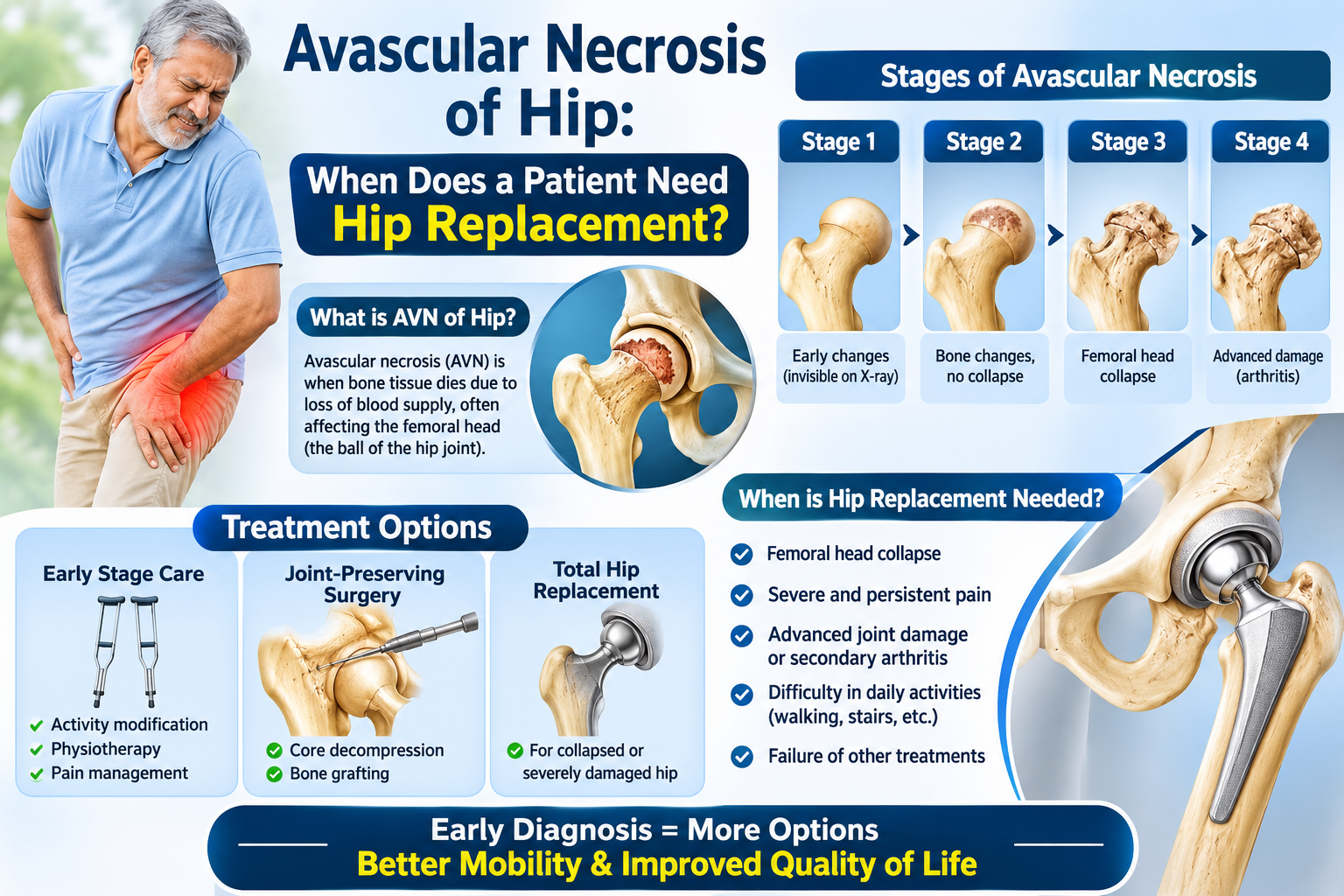
Avascular Necrosis of Hip: When Does a Patient Need Hip Replacement?
Imagine a hip that aches a little after a long walk, then aches while you sit, then wakes you up at night. Many people put this down to a pulled muscle or age. Sometimes, though, the real cause is avascular necrosis of hip, a condition where part of the thigh bone’s rounded top loses its blood supply and slowly weakens. The earlier it is found, the more options a patient usually has.
Quick answer: Hip replacement for avascular necrosis is usually considered when the femoral head has collapsed, the joint is badly damaged, pain stays severe despite treatment, and everyday activities like walking or climbing stairs become difficult. Early AVN without collapse can often be managed with joint-preserving treatment first, depending on imaging, age and overall health.
What Is Avascular Necrosis of the Hip?
Avascular necrosis (AVN), also called osteonecrosis, means bone tissue dies because blood is not reaching it. In the hip, the ball of the joint, called the femoral head, is the area most often affected.
Bone is living tissue. It needs a steady blood supply to repair itself every day. When that supply drops, the bone cells in the area start to die, and the bone slowly becomes weak and brittle.
At first the surface of the femoral head may look normal. As the weakened bone keeps taking the load of body weight, tiny cracks can form beneath the cartilage. Over time the surface can cave in, and the smooth ball becomes uneven. This is called femoral head collapse, and it is the turning point in the condition.
Once the ball is no longer round, it no longer glides smoothly inside the socket. The cartilage wears away faster, and the joint can become painful and stiff.
People often confuse AVN with hip osteoarthritis. Osteoarthritis is a wear-and-tear process that mainly starts in the cartilage and tends to develop gradually in older adults. AVN starts in the bone because of lost blood supply, and it can affect people in their 30s, 40s and 50s. AVN can lead to arthritis later, but the starting point is different, and so is the early treatment approach.
What Are the Symptoms of Avascular Necrosis of the Hip?
Early on, there may be no symptoms at all. Many people find out only when an MRI is done for some other reason, or when pain finally starts. The typical avascular necrosis hip symptoms build up gradually, which is why they are easy to ignore.
Common signs include:
- Pain deep in the groin, which may also be felt in the buttock or thigh
- Pain while walking, standing for long periods or bearing weight on the leg
- Pain that gets worse with activity such as climbing stairs or exercising
- Reduced range of movement, for example trouble putting on socks or crossing the legs
- A limp, often because the person unconsciously avoids putting weight on the sore hip
- A stiff joint in later stages, along with pain even at rest or at night
Pain is usually the first thing patients notice, and hip pain due to avascular necrosis often feels different from a muscle strain. It tends to be deep, nagging and persistent, and it may not settle with a few days of rest.
Some people also feel a catching or grinding sensation once the surface has collapsed. If your pain lasts more than a couple of weeks, especially if you have a risk factor, it is worth getting it checked.
What Are the Different Stages of Avascular Necrosis of the Hip?
Doctors describe how far the condition has progressed using a staging system. The two most commonly used are the Ficat and Arlet system and the ARCO (Association Research Circulation Osseous) system. They differ in detail, but the idea is the same: how much damage is visible, and has the femoral head collapsed?
Understanding the stages of avascular necrosis of hip matters because treatment choices change sharply once collapse happens. Staging is based on X-rays and MRI, along with the symptoms the patient describes.
|
Stage |
What Is Happening |
Imaging Findings |
Usual Treatment Direction |
|
Stage 1 |
Early changes in bone; blood supply is reduced |
X-ray usually normal; MRI may show changes |
Monitoring, protected weight-bearing, pain control, sometimes joint-preserving surgery |
|
Stage 2 |
Bone changes are visible, but the ball is still round |
X-ray may show areas of density change or small cysts; no collapse |
Joint-preserving options such as core decompression are often considered |
|
Stage 3 |
Subchondral fracture or femoral head collapse |
X-ray shows a crescent-shaped line or flattened surface |
Limited joint-preserving options in selected cases; hip replacement is often considered |
|
Stage 4 |
Advanced joint damage with secondary osteoarthritis |
Collapse, reduced joint space, changes in the socket |
Hip replacement is generally the main option |
The ARCO system further divides stage 3 based on how much the surface has collapsed, which helps surgeons judge whether saving the joint is still realistic. Your surgeon will explain which system they use and what your stage means for you.
Not every patient moves through all four stages at the same pace. In some people progression is slow, and in others collapse happens within months, so regular follow-up is important.
What Causes Hip Joint Damage Due to AVN?
Anything that reduces blood flow to the femoral head can set off the process. Sometimes more than one factor is involved.
Long-term corticosteroid use: High doses or prolonged use of steroid medicines, often prescribed for autoimmune disease, severe allergies or other medical conditions, are among the most common causes. Patients should never stop prescribed steroids on their own; the decision should always be made with their doctor.
Excessive alcohol consumption: Heavy, long-term drinking is a well-known risk factor, although the exact mechanism is still being studied.
Hip injuries and fractures: A hip dislocation or a fracture of the neck of the femur can damage the blood vessels supplying the femoral head.
Certain medical conditions: These include sickle cell disease, lupus, some clotting disorders and certain conditions that affect fat metabolism or blood vessels.
Reduced blood circulation: Any process that blocks or narrows the small vessels feeding the bone can contribute.
Unknown cause: In some patients, doctors cannot find a clear trigger. This is called idiopathic AVN, and it does not mean the patient did anything wrong.
In most cases, hip joint damage due to AVN does not happen overnight. It develops as the weakened bone is slowly stressed by daily movement, which is why early detection gives such an advantage.
What Are the Treatment Options for Avascular Necrosis of the Hip?
There is no single plan that suits everyone. The right treatment for avascular necrosis of hip depends on the stage, the size of the damaged area, the patient’s age, symptoms and general health. In general, the aim at early stages is to protect and preserve the natural joint, and at later stages to relieve pain and restore movement.
When people search for AVN hip treatment, they often hope for a medicine or injection that will reverse the damage. At present, no medication or therapy has been reliably proven to reverse established AVN. Treatment focuses on slowing progression, protecting the bone and managing symptoms, and then on surgery when needed.
Early Stage AVN Treatment
When the femoral head has not collapsed, doctors often try to preserve the joint. Early stage AVN treatment commonly includes:
- Activity modification, such as avoiding high-impact activities like running and jumping
- Protected weight-bearing, using crutches or a walker to reduce load on the hip, as advised by the surgeon
- Pain management with medicines prescribed by the doctor
- Physiotherapy to maintain movement and strengthen the muscles around the hip
- Regular imaging and orthopedic follow-up to see whether the bone is stable or changing
Medicines like bisphosphonates and treatments like stem cell injections have been studied, but evidence is still limited and mixed. They should be described as emerging or investigational, not as proven cures, and any such option should be discussed carefully with a qualified specialist.
Non-surgical care does not repair dead bone, and some patients still progress even with good compliance. That is why close monitoring is as important as the treatment itself.
Core Decompression Surgery
Core decompression is a joint-preserving procedure. The surgeon drills one or more small channels into the femoral head and neck, through the damaged area. The idea is to reduce pressure inside the bone and encourage new blood vessels and healing. Sometimes bone graft material or other biological material is added into the channel.
It may benefit selected patients whose femoral head has not collapsed, usually in the earlier stages. Younger patients with smaller areas of damage are often better candidates.
Results vary. Core decompression can reduce pain and may delay or avoid the need for replacement in some patients, but it does not work for everyone. It is generally less useful once the surface has collapsed.
The main point to understand about AVN hip surgery of this type is that it is meant to buy time and protect the natural joint, not to guarantee a permanent fix. Your surgeon should explain realistic expectations and the possibility of needing further surgery later.
Bone Grafting and Other Joint-Preserving Procedures
Other options include bone grafting, where healthy bone is placed into the damaged area to support the cartilage surface, and in some cases vascularized grafts, where a piece of bone is transferred along with its blood vessels. Realigning the hip bone (osteotomy) is sometimes considered in carefully selected patients so that healthy bone takes more of the weight.
These procedures are technically demanding, and they tend to suit younger patients with limited damage and no major joint arthritis. They usually involve a longer period of protected walking afterwards.
Their limitations are real. If the femoral head has already collapsed badly or arthritis has set in, the chance that they will work drops, and replacement may be the more predictable choice.
Total Hip Replacement for AVN
Total hip replacement for AVN involves removing the damaged femoral head and the worn surface of the socket, and replacing them with an artificial ball and socket. The ball is attached to a stem placed in the thigh bone, and the socket is lined with a smooth liner.
It becomes necessary when the natural joint can no longer be saved, usually after collapse and joint damage. By replacing the damaged bone and cartilage with smooth implant surfaces, the operation removes the source of pain and helps the hip move more normally again.
The surgery is done under anesthesia, and the surgeon chooses the implant type and approach based on the patient’s anatomy, age and activity needs.
Here is a simple comparison of the main treatment routes.
|
Treatment |
Best Suited For |
Main Aim |
Key Limitation |
|
Observation, protected weight-bearing and physiotherapy |
Very early AVN, small or silent lesions |
Protect the bone and relieve symptoms |
Does not repair dead bone; progression is possible |
|
Core decompression |
Pre-collapse AVN, selected younger patients |
Relieve pressure and support healing |
May not prevent collapse in all patients |
|
Bone grafting / osteotomy |
Selected pre-collapse or early-collapse cases |
Support the joint surface |
Complex surgery; less reliable once arthritis is present |
|
Total hip replacement |
Collapse, advanced damage, secondary arthritis |
Relieve pain and restore function |
Major surgery; implant has a finite lifespan |
When Does a Patient Need Hip Replacement for Avascular Necrosis?
This is the question most patients really want answered. There is no single test that decides it. The surgeon looks at the whole picture, and a patient usually needs replacement when several of the following are present:
- Femoral head collapse: Once the ball has lost its round shape, it is very hard to restore it, and the joint surface tends to wear quickly.
- Severe and persistent hip pain: Pain that continues at rest or at night, and does not improve with medication and activity changes.
- Advanced joint damage: X-rays or MRI show significant damage to both the ball and the socket.
- Secondary osteoarthritis: The cartilage has worn away and the joint space has narrowed.
- Difficulty with everyday activities: Walking short distances, climbing stairs, getting in and out of a chair or sleeping comfortably becomes hard.
- Failure of suitable joint-preserving treatment: Pain or collapse continues despite appropriate non-surgical or surgical joint-preserving care.
The decision also depends on age, general health, bone quality, activity level and personal goals. Two patients with the same X-ray can need different plans.
A good surgeon will not rush you into surgery, nor will they let you suffer indefinitely. They will explain the reasons for their advice and the alternatives, so the choice is a shared one.
Is Hip Replacement Necessary for Every AVN Patient?
No. Early-stage AVN does not automatically mean hip replacement. Small lesions that are not under heavy load may stay stable for years, and some people are managed with monitoring alone. Others respond to joint-preserving surgery done before collapse.
In early stages, the focus is on protecting the natural hip, using protected walking, physiotherapy, medicines for pain and sometimes core decompression or grafting. The aim is to delay or avoid replacement, especially in younger patients.
In advanced stages, where the femoral head has collapsed and arthritis is present, the focus shifts to relieving pain and restoring function. Joint-preserving procedures have much lower chances of success at this point, so replacement becomes the main option.
The takeaway: the stage at diagnosis largely shapes the options, which is why getting hip pain evaluated early matters so much.
What Are the Benefits of Hip Replacement for AVN?
For patients with advanced damage, surgery can make a meaningful difference. The main hip replacement benefits for AVN include:
- Pain relief, since the damaged bone and cartilage are removed
- Improved walking ability and less limping
- Better joint function and range of movement
- Easier daily activities such as dressing, bathing, using stairs and getting in and out of vehicles
- Better overall quality of life, including sleep and independence
Outcomes are good for many patients, but no surgeon can promise a specific result. Results depend on the patient’s health, the underlying cause of AVN, the quality of bone, the surgical technique and how well rehabilitation is followed.
Like any major operation, hip replacement carries risks, such as infection, blood clots, implant loosening, dislocation and differences in leg length. These should be discussed openly before surgery.
What Is Recovery Like After Hip Replacement for AVN?
Every patient recovers at a different pace, so it helps to think in stages rather than fixed dates. Your surgeon and physiotherapist will tailor the plan to you.
First 24–48 hours: Pain control, wound care and early movement are the priorities. Many patients are helped to sit up and stand within this period, as advised by the team.
Initial walking with assistance: You will usually start with a walker or crutches, with a physiotherapist guiding you. The goal is to get moving safely while protecting the new joint.
Physiotherapy and rehabilitation: Exercises restore strength, balance and movement. Doing them regularly, as prescribed, is one of the biggest factors in how well you do.
Gradual return to daily activities: Light household tasks, short walks and, later, driving or desk work are reintroduced step by step. Timing depends on the person, the job and the surgeon’s advice.
Follow-up appointments: Check-ups with X-rays help the surgeon confirm that the implant is settling well and healing is on track.
Long-term precautions: You may be advised to avoid certain high-impact activities and to keep to a healthy weight. If you have a background condition linked to AVN, continuing regular medical care also matters.
Patients often ask how long recovery after hip replacement for AVN takes. The honest answer is that it varies with age, fitness, bone health and how the surgery went, so your own surgeon is the best person to give a realistic timeline.
How Can Patients Prevent Further Avascular Necrosis of Hip Damage?
Not every case can be prevented, but there is a lot patients can do to protect their joints and avoid further damage.
- Get persistent hip pain checked early instead of waiting for it to worsen
- Attend regular follow-ups and imaging as advised, even if you feel better
- Modify activities to lower stress on the hip, especially high-impact movements
- Avoid smoking and limit alcohol, since both can affect bone and blood vessel health
- Never stop or change steroid medicines on your own; speak to your doctor, who can weigh the benefits and risks
- Tell your doctor if you have a condition or medicine that raises AVN risk, and ask whether the other hip needs monitoring
Because AVN can affect both hips, checking the other side when symptoms are present, or when a risk factor exists, is a reasonable conversation to have with your specialist.
When Should You Consult an Orthopedic Specialist?
Please see an orthopedic specialist if you notice:
- Groin or hip pain that lasts more than a couple of weeks
- A new limp or difficulty putting weight on the leg
- Night pain or pain at rest
- Stiffness that makes dressing, climbing stairs or walking harder
- Hip pain along with a history of steroid use, heavy alcohol use, a hip injury or a related medical condition
Hip pain that keeps returning is not something to push through. A physical examination and imaging such as X-ray and MRI can usually show what is going on. If you cannot bear weight at all after a fall or injury, seek urgent medical care.
Frequently Asked Questions About AVN of the Hip
1. Does every patient with AVN need hip replacement?
No. Small or early-stage lesions may be monitored or treated with joint-preserving methods. Replacement is usually reserved for patients with femoral head collapse, advanced joint damage or severe pain that no longer responds to other treatment. The decision depends on imaging, symptoms, age and overall health.
2. What is the best treatment for early-stage AVN?
There is no single best option. Early-stage care often combines protected weight-bearing, activity changes, pain management, physiotherapy and close monitoring. Some patients with pre-collapse disease may be offered core decompression or similar procedures. Your orthopedic surgeon chooses based on the size and location of the damage.
3. At what stage of AVN is hip replacement needed?
Hip replacement is most often considered at stage 3 or stage 4, when the femoral head has collapsed or arthritis has developed. It may also be advised earlier if pain is severe and other treatments have failed. The final decision is individual.
4. Can avascular necrosis be reversed without surgery?
Established AVN is not reliably reversed by medicines or non-surgical care. Rest, protected weight-bearing and physiotherapy can ease symptoms and may slow progression, but dead bone does not simply regrow. Emerging treatments are still being studied and should not be seen as proven cures.
5. Is core decompression better than hip replacement?
They serve different purposes. Core decompression aims to save the natural joint before collapse, while hip replacement is for joints that are already collapsed or badly damaged. Neither is better for everyone. The right choice depends on the stage, age and expected outcome.
6. How long does hip replacement recovery take for AVN?
Recovery varies from person to person. Most patients begin walking with support soon after surgery and then progress through physiotherapy in stages. How quickly you return to full activity depends on age, health, bone quality and rehabilitation. Your surgeon can give a personal estimate.
7. Can AVN affect both hips?
Yes. AVN can involve both hips, particularly when it is linked to long-term steroid use, alcohol, or certain medical conditions. Sometimes the second hip is affected without causing symptoms at first. Your doctor may suggest imaging of the other hip.
8. What happens if avascular necrosis is left untreated?
Untreated AVN often progresses. The weakened bone may collapse, the cartilage can wear down, and arthritis can develop, leading to increasing pain, stiffness and limited movement. Some small lesions stay stable, but only proper evaluation can tell which situation applies.
9. Is total hip replacement successful for AVN?
For many patients with advanced AVN, hip replacement relieves pain and improves function. Results depend on factors such as age, general health, cause of AVN and bone quality. As with any surgery, risks exist, and no specific outcome can be guaranteed.
10. Can a young patient undergo hip replacement for AVN?
Yes, when the joint is badly damaged and other options are no longer suitable. Because younger patients are more active and may need the implant for many years, surgeons weigh implant choice and timing carefully, and often try joint preservation first if it is still possible.
Final Thoughts
Living with avascular necrosis of hip can feel worrying, but understanding the condition puts you in a stronger position. Early stages offer more ways to protect the natural joint, while advanced stages can often be handled well with modern surgery. The key is to act on persistent hip pain instead of waiting.
If you suspect AVN or have been diagnosed, speak with a qualified orthopedic surgeon, ask what stage you are at, and discuss every option, including the pros and cons of each.