
Hip Replacement Surgery in Tardeo, Mumbai
Walk, climb stairs and sleep without hip pain. Dr. Safiuddin Nadwi guides you from your first consultation to full recovery.

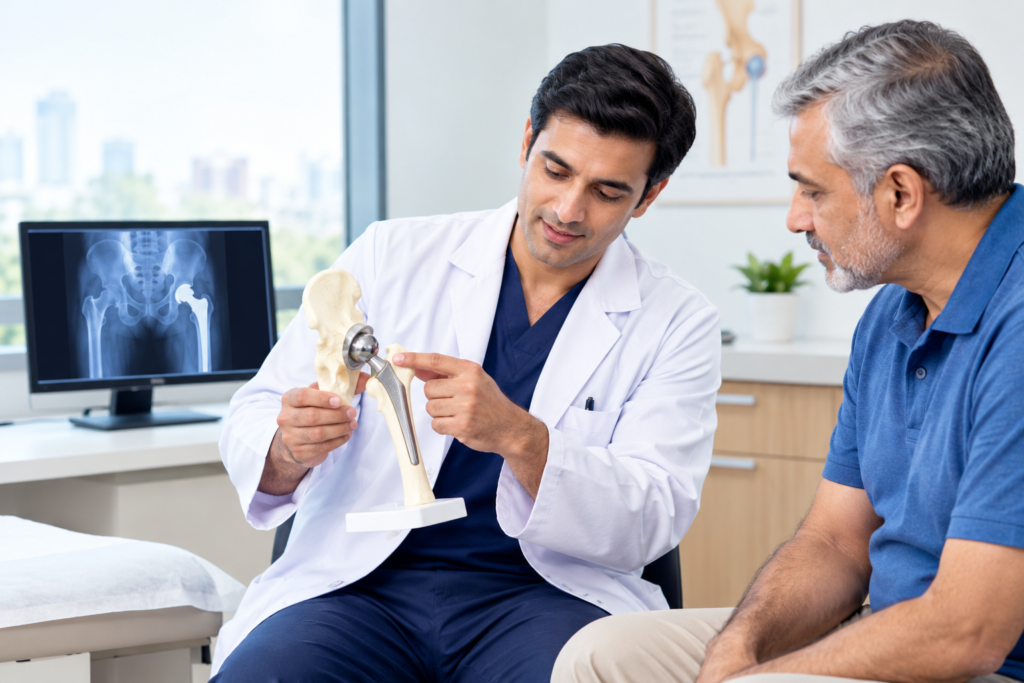
Hip pain has a way of shrinking your life. First you skip the evening walk. Then the stairs start to feel like a mountain, and getting out of a car or tying your shoes becomes a task you plan for. If this sounds familiar, hip replacement surgery in Mumbai may give you that freedom back.
Dr. Safiuddin Nadwi is a robotic joint replacement and hip replacement surgeon in Mumbai with 13 years of experience and more than 1,000 successful surgeries. He offers hip replacement in Tardeo at Apollo Spectra Hospital, and also consults at Saifee Hospital and Ozone Health Care in Mumbai Central.
Here you will find honest answers about the signs you need a hip replacement, how the operation works, hip replacement recovery time, hip replacement cost in Mumbai and the risks, so you can decide without pressure.
Hip Replacement at a Glance: Surgery Time, Hospital Stay and Recovery Time
| Question | Answer |
|---|---|
| How long does the operation take? | About 1 to 2 hours. |
| How many days in hospital? | Usually 1 to 3 days. |
| When will I take my first steps? | The day after surgery, with support. |
| How long is full recovery? | Close to normal in 3 to 6 months. |
| How long does the implant last? | Commonly 15 to 20 years or more. |
| Does it work? | More than 95 in 100 patients get relief from hip pain. |
What Is Total Hip Replacement?
Your hip is a ball and socket joint. When the cartilage wears away, the bone ends rub against each other, and that is what hurts. Total hip replacement, also called total hip arthroplasty, is an operation that removes the damaged ball and socket and fits smooth new parts made of metal, ceramic or strong plastic.
It is one of the most established operations in orthopaedics. It works best when the joint is badly worn but your general health is good enough for surgery. The aim is simple: less pain, a stable hip and a return to the things you enjoy.
Signs You Need a Hip Replacement: Hip Pain When Walking and More
Hip pain alone does not mean surgery. But if several of these sound like you, it is time for an assessment:
Hip pain when walking, felt in the groin, thigh or buttock, that returns every few steps
- Pain that wakes you at night or stops you finding a comfortable position
- Stiffness that makes socks, shoes, squatting or getting into a car difficult
- Trouble climbing stairs or standing up from a chair
- A limp, or a need for a walking stick
- Walks that get shorter every month
A simple test: ask yourself what you have stopped doing because of your hip. If that list keeps growing, do not wait until the pain is unbearable. Early advice gives you more choices, and only an examination and an X-ray can confirm whether replacement is the right step.
Hip Replacement for Arthritis and Other Hip Conditions
| Condition | What Happens in the Hip |
|---|---|
| Osteoarthritis | Cartilage wears away and bones rub together. |
| Rheumatoid Arthritis | Inflammation damages the joint lining and cartilage. |
| Avascular Necrosis (AVN) | Poor blood supply makes the ball of the hip collapse. |
| Hip Fracture | A broken neck of the thigh bone that cannot be repaired well. |
| Hip Dysplasia | A shallow socket from birth that wears the joint early. |
| Old Injury | Damage after a fracture or dislocation years ago. |
- ROSA robotic
- MAKO robotic
- Robotic Knee Replacement
- Primary Knee Replacement
- Robotic Hip Replacement
- Primary Hip Replacement
- Total Hip Replacement in Dadar
- Total Knee Replacement in Dadar
- Total Hip Replacement Surgeon in Worli
- Partial Knee Replacement Surgeon in Worli
- Knee Replacement Surgeon in Mumbai
- Best Orthopedic Surgeon in Mumbai
- Best Orthopedic Surgeon in Worli
- Best Orthopedic Surgeon in Dadar
About Dr. Safiuddin Nadwi, Senior Orthopedic and Joint Replacement Surgeon in Dadar Mumbai

Dr. Safiuddin Nadwi is a senior orthopedic surgeon and joint replacement specialist at Dr. Joints Clinic, Dadar, Mumbai. Over 15 years of focused clinical experience, he has performed thousands of successful orthopedic procedures including robotic-assisted knee and hip replacements, total and partial knee arthroplasty, hip arthroplasty, arthroscopic knee surgery, ACL reconstruction, fracture fixation, and complex revision joint replacement surgeries.
He completed advanced postgraduate training in orthopedic surgery with specialized fellowship exposure in joint replacement techniques, robotic-assisted surgical systems, and minimally invasive orthopedic procedures. His surgical practice covers the complete range of bone and joint conditions, from early-stage knee arthritis managed without surgery to complex cases where previous joint replacements have failed and revision surgery is required.
Dr. Nadwi is known in Dadar and Central Mumbai for three things: accurate diagnosis, honest advice, and clean surgical outcomes. He takes time during every consultation to study your imaging carefully, explain your condition in plain language, and walk you through every available option including non-surgical ones. He will tell you directly whether you need surgery now, later, or not at all. He does not recommend surgery to every patient who walks in.
Over 15 years, his practice at Dadar has grown almost entirely through patient referrals. When a patient refers their spouse, parent, or colleague to the same surgeon, that is the clearest indicator of trust.
Avascular Necrosis of Hip Treatment
In very early AVN, the hip can sometimes be protected with medicines, protected weight bearing or procedures that try to save the joint. An MRI and a careful examination decide the stage. Once the ball of the hip has collapsed, waiting rarely helps, and hip replacement usually gives lasting relief.
Hip Replacement Without Surgery: What to Try First
Hip replacement without surgery is not possible once the joint is badly worn, but treatment can reduce pain and delay the operation:
- Pain relief and anti inflammatory medicines
- Weight loss, which reduces the load on the hip
- Physiotherapy to strengthen the muscles around the joint
- A walking stick in the opposite hand
- Joint injections in selected cases
These steps help many people for a while. They cannot rebuild a joint that has worn out. When pain keeps controlling your day, surgery is the option that gives lasting relief. We will never push you towards an operation you do not need.
What Happens at Your First Hip Consultation
Many patients arrive nervous, so here is exactly what to expect:
- Your story. Dr. Nadwi asks where it hurts, when it started, what makes it worse and what you can no longer do.
- Examination. He checks your movement, strength, walking and leg length.
- Imaging. An X-ray is usually enough. An MRI or CT scan may be advised for AVN or for robotic planning.
- Options. You hear your choices, including treatment without surgery, in plain language.
- Estimate. If surgery is suggested, you get a clear explanation of the plan and the likely cost.
Bring your old X-rays, reports and a list of your medicines.
Why Choose Dr Joints?

Patient focused care
Personalized treatment plans for the better recovery.
Knee & Hip Specialization
Personalized treatment plans for the better recovery.

Robotic-Assisted Options
Personalized treatment plans for the better recovery.
How Hip Replacement Surgery Is Done Step by Step
You are under spinal or general anaesthesia, and the operation follows these steps:

1. Step
Anaesthesia. Spinal or general, chosen by your anaesthetist for your safety.

2. Step
Opening the hip. The surgeon works through a carefully planned approach.

3. Step
Removing the damaged joint. The worn ball and the damaged socket surface are taken out.
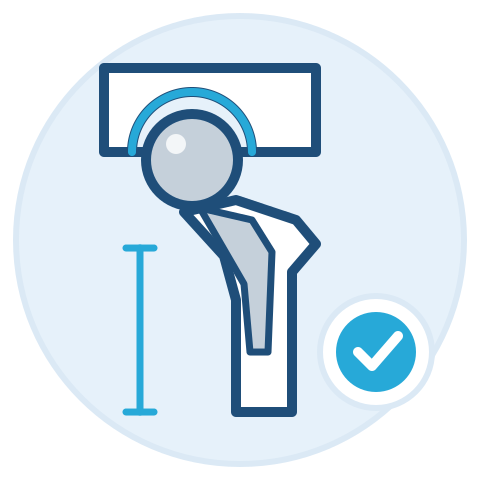
4. Step
Fitting the new joint. The socket, stem and ball are placed and tested for fit, leg length and stability.

5. Step
Recovery room. The wound is closed and you are monitored.
How Long Does Hip Replacement Surgery Take?
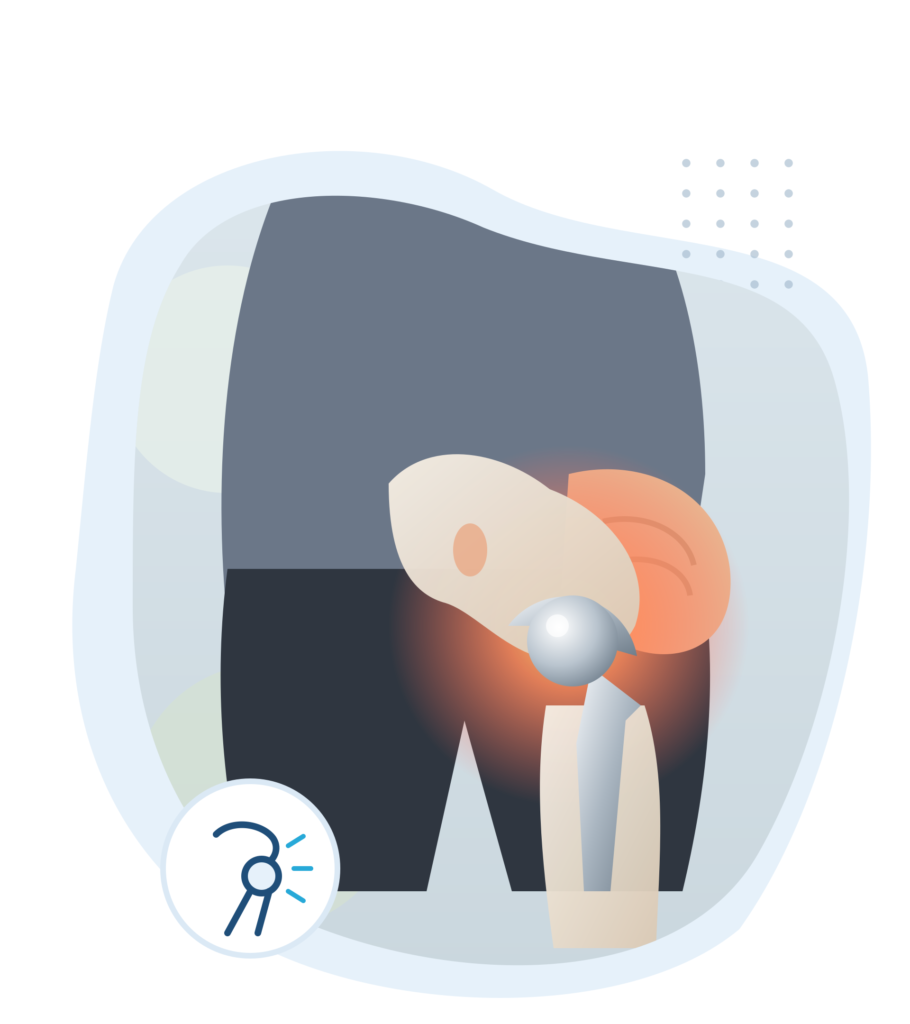
The operation itself takes about 1 to 2 hours. You will be in the operating area longer for anaesthesia and monitoring. Revision surgery, where an old implant is replaced, often takes longer.
Robotic Hip Replacement in Mumbai with MAKO Technology
Robotic hip replacement in Mumbai is one of Dr. Nadwi’s main areas of work. For selected patients, it gives the surgeon a detailed plan and a very accurate way to place the implant.
Before surgery, a 3D CT scan of your hip is used to plan the operation. During surgery, the MAKO robotic system helps place the implant exactly where the plan says.
Dr. Nadwi also works with the ROSA robotic system for joint replacement.
The goals of robotic assisted surgery are:
- Accurate implant position and alignment
- Less damage to the tissue around the joint
- Smaller incisions where the case allows it
- A smoother, faster recovery
- Better long term implant life
Robotic surgery does not suit every patient, and Dr. Nadwi will tell you honestly whether it adds value in your case.
How to Prepare for Hip Replacement Surgery
A little preparation makes recovery easier:
- Complete the tests your surgeon asks for, such as blood tests, ECG and X-rays
- Keep sugar and blood pressure under control
- Stop smoking if you smoke, and bring your weight down if you can
- Take your regular medicines exactly as advised, and tell the team about blood thinners
- Practise the exercises the physiotherapist shows you before surgery
- Arrange help at home for the first week, a firm chair, a raised toilet seat and clear walking paths
Robotic Hip Replacement Surgery in Dadar Mumbai
Hip joint failure from advanced arthritis, avascular necrosis, hip fracture, or progressive degeneration is one of the most debilitating orthopedic conditions. Dr. Safiuddin Nadwi performs robotic hip replacement surgery using real-time robotic guidance that ensures accurate implant positioning and precise alignment of the hip joint. Correct positioning directly determines how long a hip replacement lasts and how well it functions over time.
Most patients treated by Dr. Nadwi are standing and walking with support within 24 hours of hip replacement surgery. Recovery is structured, supervised, and designed to restore independence as quickly and safely as possible.
Total Knee Replacement Surgery in Dadar
Total knee replacement, also called total knee arthroplasty or TKR, involves removing the damaged joint surfaces of the knee and replacing them with high-grade metal and plastic implants designed to replicate normal knee movement. Dr. Safiuddin Nadwi has performed a high volume of total knee replacements over his 15-year career, treating patients with severe osteoarthritis, rheumatoid arthritis, and joint damage following trauma.
Physiotherapy begins on the day of surgery or the following morning. Most patients walk with a frame within 24 to 48 hours, return home within 3 to 5 days, and walk independently without a walking aid within 6 to 8 weeks of surgery.
Partial Knee Replacement in Dadar Mumbai
When knee arthritis is limited to a single compartment of the joint, partial knee replacement is a more conservative and less invasive surgical option. It preserves more of the original knee structure, involves a smaller incision, and typically produces a faster, more comfortable recovery than full replacement. Dr. Nadwi evaluates every patient individually through clinical examination and detailed imaging before recommending partial or total replacement.
Knee Replacement Surgery Cost in Mumbai | What to Expect at Dr. Joints Clinic Dadar
Knee replacement surgery cost in Mumbai typically ranges from Rs. 1,50,000 to Rs. 3,80,000 for a single knee depending on several factors. The main factors that affect the total cost are the type of surgery (total or partial knee replacement), the surgical technique used (conventional or robotic-assisted), the implant brand and quality (standard Indian implant or imported premium implant), the hospital facility category, and the duration of hospital stay.
At Dr. Joints Clinic Dadar, the team provides a complete and transparent cost breakdown during your initial consultation. There are no hidden charges or surprise additions after surgery. Most major health insurance policies are accepted including cashless treatment at network hospitals. Patients covered under corporate health policies, government schemes, and TPA cashless plans are supported throughout the documentation process. Patients without health insurance receive a clear out-of-pocket estimate during the consultation so they can plan confidently.
Robotic knee replacement surgery costs slightly more than conventional replacement due to the technology involved, but the improved precision, faster recovery, and longer implant life make it a clinically and financially sound choice for many patients.
Robotic Knee Replacement vs Traditional Knee Replacement | Which is Right for You
This is one of the most common questions at Dr. Nadwi’s Dadar orthopedic clinic. Both procedures are effective and have strong clinical track records. The difference is in the level of precision available during surgery.
Traditional Knee Replacement
Traditional knee replacement is performed entirely by the surgeon's hands using mechanical guides and standard instruments. The outcomes are good in the majority of cases when done by an experienced surgeon.
Robotic Knee
Replacement
Robotic-assisted knee replacement adds a pre-surgical 3D planning step and intraoperative robotic guidance that helps the surgeon achieve more accurate implant positioning, better alignment, and a more personalized fit based on the patient's exact anatomy.
For younger patients who need long implant life, patients with unusual anatomy or deformity, and patients with specific functional demands, robotic surgery delivers measurably better outcomes.
Dr. Nadwi uses robotic technology when it genuinely adds clinical value for that specific patient. He does not promote it as a default premium upgrade for everyone. He will explain during your consultation whether robotic surgery is appropriate for your knee and why.
Patient Recovery Timeline After Knee and Hip Replacement Surgery
Understanding what recovery looks like is one of the most important parts of deciding to proceed with joint replacement surgery. Here is what patients typically experience under Dr. Safiuddin Nadwi’s care at Dadar.
On the day of surgery or the following morning, physiotherapy begins in the hospital ward. Most patients stand and take assisted steps within 24 hours. Hospital discharge happens between day 3 and day 5 depending on recovery progress. By week 2 to 3, most patients are walking at home with a walking frame and managing basic daily activities with support. By week 6 to 8, the majority of patients are walking independently without a walking aid on flat surfaces. By month 3, patients manage stairs, light outdoor walking, and most household activities without difficulty. Full recovery with return to all normal activities takes 3 to 6 months depending on age, general fitness level, and how consistently the patient follows the prescribed physiotherapy plan.
Conditions Treated by Dr. Safiuddin Nadwi, Bone and Joint Specialist in Dadar
Dr. Nadwi treats the full spectrum of bone and joint conditions at his Dadar orthopedic clinic. These include knee osteoarthritis and hip osteoarthritis at all stages, rheumatoid arthritis and other inflammatory joint diseases, avascular necrosis of the hip and knee, ACL tears, PCL tears, meniscus injuries, and multi-ligament knee injuries, rotator cuff tears and shoulder joint problems, sports injuries in both recreational and professional athletes, fractures and trauma requiring surgical fixation, osteoporosis and metabolic bone disease, spinal conditions including disc herniation, lumbar spondylosis, and spinal stenosis, pediatric orthopedic conditions including clubfoot, hip dysplasia, and scoliosis, and revision joint replacement surgery where previous replacements have failed.
Why Choose Dr. Safiuddin Nadwi as Your Orthopedic Surgeon in Dadar
- 15 Years of Focused Orthopedic and Joint Replacement Experience Dr. Safiuddin Nadwi brings 15 years of dedicated orthopedic surgical practice to every patient. That experience spans routine cases, high-volume joint replacement, complex revision surgeries, pediatric cases, and trauma surgery. Depth of experience translates directly into better surgical judgment, fewer complications, and better outcomes for patients.
- Advanced Robotic Surgery Expertise in Dadar Dr. Nadwi is among the few orthopedic surgeons in Dadar with extensive experience in robotic-assisted knee and hip replacement. Consistent outcomes with robotic surgery require a high case volume and ongoing technical proficiency. He has both.
- Honest, Conservative Approach to Treatment Dr. Nadwi does not recommend surgery to patients who do not genuinely need it. Many patients at his Dadar clinic are managed effectively without any surgical intervention. When surgery is the right answer, he explains it clearly and gives you the full picture of what to expect before, during, and after the procedure.
- Transparent Costs and Insurance Support Full cost transparency is standard practice at Dr. Joints Clinic. All major health insurance policies and cashless TPA facilities are accepted. Patients without insurance receive a clear out-of-pocket cost breakdown during consultation.
- Convenient Location for Patients Across Central Mumbai Dr. Joints Clinic is located in Dadar, directly accessible from Dadar railway station on the Western and Central lines. Patients from Parel, Mahim, Matunga, Wadala, Sion, Byculla, Worli, and Shivaji Park reach the clinic easily by train, bus, or road.
Book an Appointment with the Best Orthopedic Surgeon in Dadar Mumbai
If knee pain, hip pain, a sports injury, or any bone and joint problem is affecting your daily life, do not delay getting it assessed. The earlier you consult a specialist, the more treatment options remain available to you and the better your long-term outcome.
Book a consultation with Dr. Safiuddin Nadwi at Dr. Joints Clinic, Dadar today. With 15 years of orthopedic and joint replacement experience, advanced robotic surgery expertise, and a patient-first approach built on honesty and clinical precision, Dr. Nadwi is one of the most trusted orthopedic surgeons in Dadar and Central Mumbai.
Call the clinic directly or fill in the appointment request form on this page. Walk in with your existing X-rays or MRI scans if you have them. Same-day and next-day appointments are available for patients in pain.
📍 Visit our clinic or call now to schedule a consultation!
Hip Replacement Recovery Time: Day by Day Timeline
Most patients walk with support the day after surgery, spend 1 to 3 days in hospital and return to normal daily life in around 3 to 6 months.
| When | What Usually Happens |
|---|---|
| Day 1 | You sit up, stand and take first steps with a walker. |
| Day 2 to 3 | Walking and stair practice, and discharge for most patients. |
| Week 2 | Wound check and more walking each day. |
| Week 6 | Walking aids often reduced, driving possible if your surgeon agrees. |
| Month 3 | Most daily activities feel normal. |
| Month 6 | Close to full recovery. |
These are general timelines, not promises. Age, fitness and other health conditions make recovery faster or slower, and your strength can keep improving for up to a year.
Hip Replacement Physiotherapy: Your Exercise Plan After Surgery
The operation fixes the joint, and physiotherapy gives you the strength to use it. Start gentle exercises in hospital, walk a little more every day and attend every follow up visit. Walking every hour or two while you are awake is one of the best things you can do, because it helps healing and lowers the risk of blood clots.
What to Do and What to Avoid at Home
Do walk daily, use your walker or sticks as advised, and take your medicines on time
- Do keep someone with you for the first few days
- Do use one floor living if you can
- Avoid high impact activity such as running, and avoid climbing high ladders
- Avoid movements your surgeon has told you to avoid for your type of surgery
- Avoid swimming or a hot tub until your wound has healed and your surgeon agrees
How Long Does a Hip Replacement Last?
A modern hip implant commonly lasts 15 to 20 years, and often longer. Large studies report that about 90 to 95 percent of hip replacements are still working at 10 years, and about 80 to 85 percent at 20 years.
Your own result depends on your age, weight and how active you are. Younger and more active patients put more load on the implant. A healthy weight, low impact exercise such as walking, swimming or cycling, and regular check ups all protect your new hip. If an implant wears or loosens, a revision operation is possible.
Hip Replacement Cost in Mumbai: What Decides the Price
The cost of hip replacement in Mumbai is not one fixed number, and anyone who quotes a final price without seeing your reports is guessing. Online prices range from under Rs 1 lakh to several lakhs. These are the things that change the bill:
- The implant and how it is fixed
- Standard or robotic assisted surgery
- Hospital and room category
- Number of nights in hospital
- One hip or both hips
- Tests before surgery and physiotherapy after
Most health insurance covers hip replacement when it is medically needed, and our team helps with the estimate and documents.
Hip Replacement Risks and Complications
Hip replacement is safe for most people, but like any surgery it carries risk. The main ones are infection, blood clots, hip dislocation, a small difference in leg length, implant loosening over many years and problems linked to anaesthesia.
Dislocation is the most common problem after surgery, and it is uncommon when you follow your surgeon’s advice. Before surgery we check your heart, sugar, blood pressure and general fitness, and we plan how to lower each risk.
Get help quickly if you notice: fever, increasing redness or discharge from the wound, severe calf pain or swelling, sudden breathlessness, or a sudden inability to bear weight on the hip.
Questions to Ask Your Hip Surgeon
Good surgeons welcome questions. Ask Dr. Nadwi, or any surgeon you meet:
- Do I really need surgery now, or can I wait?
- Which type of implant and approach do you suggest for me, and why?
- Is robotic assisted surgery useful in my case?
- What are the risks for me, given my health?
- What will recovery look like for me week by week?
- What is the full estimated cost, and what does it include?
Meet Dr. Safiuddin Nadwi, Your Hip Replacement Surgeon in Mumbai
Dr. Safiuddin Nadwi is a robotic joint replacement and orthopaedic surgeon in Mumbai. He received his medical education and advanced training at respected institutions in India and abroad, and he has 13 years of experience with more than 1,000 successful surgeries.
His main work is joint replacement. He also treats trauma, sports injuries, arthritis and osteoporosis, and he has experience in minimally invasive surgery, spine care and pediatric orthopaedics. That wider background matters, because hip pain is not always only a hip problem, and he looks at the whole picture before suggesting surgery.
He uses robotic technology, the MAKO and ROSA robotic systems, to plan and perform joint replacement with high accuracy. Patients with osteoarthritis, rheumatoid arthritis and joint injuries come to him for it.
What patients value most is how he works. He treats the patient and not only the X-ray, explains your condition in plain words, and believes you should understand every step of your treatment. His goal is faster recovery, less pain and better long term results, and his mission is to improve your mobility and quality of life with expert and compassionate care.
Dr. Nadwi at a glance
Experience: 13 years in orthopaedics and joint replacement
- Surgeries: more than 1,000 successful surgeries
- Training: medical education and advanced training in India and abroad
- Technology: MAKO and ROSA robotic systems
- Skills: joint replacement, trauma care, sports injuries, minimally invasive surgery, spine care, pediatric orthopaedics, arthritis and osteoporosis
- Consultations: Apollo Spectra Hospital in Tardeo, Saifee Hospital, and Ozone Health Care in Mumbai Central
- In the news: Dr. Nadwi in the media
Why patients choose Dr. Nadwi
- Honest advice. You hear whether you need surgery now, later or not at all.
- A personal plan. Treatment is planned around your condition, your age and your lifestyle.
- Robotic precision. 3D planning matched to your joint, for the patients it suits.
- Clear communication. Plain answers, no pressure, and time for your questions.
- One team from start to finish. Assessment, surgery, physiotherapy and follow up with the same doctor.
Why You Can Trust This Information
Based on real practice. It reflects 13 years of joint replacement experience and more than 1,000 successful surgeries, together with standard orthopaedic guidance.
Sources you can check. The sources are listed at the end, so you can read them yourself.
Honest numbers. Timelines and costs are ranges, not promises, and we say clearly when something depends on you.
No pressure. If surgery is not right for you, we will tell you.
Hip Replacement in Tardeo: Locations and Timings
Patients travel to us from Tardeo, Worli, Dadar, Mumbai Central, Byculla, Mahalaxmi and nearby areas.
Opening Hours
If Worli is closer to you, see our details for a total hip replacement surgeon in Worli.
Living in Dadar? Look at total hip replacement in Dadar.

Book Your Hip Replacement Surgery Consultation in Tardeo, Mumbai
Bring your X-rays and reports to your first visit. Dr. Nadwi will tell you honestly whether you need surgery, what your options are and what it is likely to cost.

Call Now
+91 88818 87838
Frequently Asked Questions About Hip Replacement Surgery in Mumbai
Very high. More than 95 in 100 patients get relief from hip pain. About 90 to 95 percent of implants are still working at 10 years and about 80 to 85 percent at 20 years, according to figures from the American Academy of Orthopaedic Surgeons. These are international figures, and your result depends on your age, health and rehabilitation.
There is some pain after surgery, but it is controlled with medicines and fades quickly. A planned pain relief routine keeps you comfortable. Most patients say the old arthritis pain is gone or much lower within weeks, and early walking helps healing.
Yes, it is a major operation, and also one of the safest and best studied in orthopaedics. It involves anaesthesia, removing damaged bone and fitting an implant. Most patients are walking the day after.
Usually 1 to 3 days. People with diabetes, heart problems or other conditions may stay longer. Your surgeon will confirm the plan before the operation.
The day after surgery, with a walker and a physiotherapist. Many people reduce support at around 4 to 6 weeks, though every body heals at its own pace.
None. You get out of bed the next day. Moving early protects you from blood clots and stiffness. You will sit, stand and walk with support from the first day.
Yes, usually within a few weeks, and you practise stairs in hospital first. Go one step at a time with the rail and follow your physiotherapist's technique.
Many people drive again at around 4 to 6 weeks, once the surgeon agrees. It depends on which hip was operated and how well you control the leg. Never drive on strong painkillers.
Avoid running, high impact sports, climbing high ladders and any movement your surgeon has told you to avoid. Do not stop your exercises or skip follow up visits. The exact limits depend on the type of surgery you had.
It depends on your surgical approach, so follow your surgeon's advice. Many patients are told to avoid crossing the legs and to sleep on the back, or with a pillow between the knees, for the first weeks. Ask Dr. Nadwi for the rules that apply to you.
Yes for low impact activity such as walking, cycling, swimming and golf. Running is generally not advised. Your surgeon will tell you when you can restart each activity.
There is no fixed minimum age. Younger patients with severe damage from AVN, injury or dysplasia do get replacements. We plan implant choice and timing carefully, because a younger patient may need revision surgery later.
No. Age alone does not stop you. Your heart, lungs, sugar control and strength matter more. Many patients in their 70s and 80s do very well, and a health check decides if it is safe.
Sometimes, in selected fit patients. Many surgeons prefer one hip at a time because it is safer and easier to recover from. Dr. Nadwi will explain the right plan if both hips are affected.
Robotic surgery uses a 3D plan and a robotic arm to guide implant placement. Standard surgery relies on instruments and the surgeon's experience. Both are proven, and Dr. Nadwi will tell you which one suits your hip.
Choose a surgeon who does joint replacement regularly, explains your options honestly and follows you through recovery. Look at experience, training, the technology used and how clearly the doctor talks to you. A good surgeon will also tell you when surgery is not needed.
It varies widely, from under Rs 1 lakh to several lakhs in online listings. The final figure depends on the implant, hospital, room, type of surgery and days in hospital. Bring your reports for a clear estimate.
In most cases yes, when the surgery is medically needed. Cover depends on your policy, room category and hospital. Check your policy first, and our team will help with the documents.
Mild or early hip pain often can. Pain from a badly worn joint usually cannot. Weight loss, physiotherapy and medicines help early problems. When the joint itself is worn out, surgery is the lasting solution.
When pain, stiffness or a limp limits your daily life and non surgical treatment no longer helps. You do not need to wait until you cannot walk at all.